
 Workplace Management
24 September 2026
Best Workplace Management Software in 2026: 6 Tools Compared
Compare six workplace management platforms. See what each is suited for and how to choose the right fit in 2026.

Deesha
|
4 Min Read
Read More
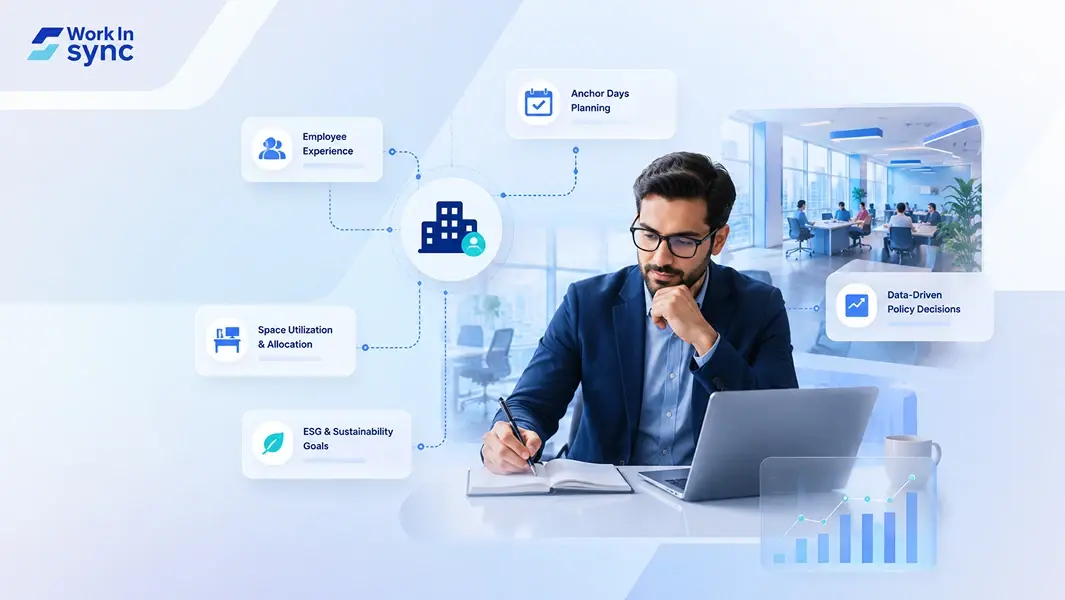
Upskilling Guide for Facility Managers Who Want to Become Workplace Experience Strategists (WXM)
“Facility Managers don’t become obsolete, they become strategists. The ones who see space as a system, not a service, will own the future of work.”
Facility Managers already own the physical layer of work: desks, rooms, parking, HVAC, and safety. But in hybrid work, policy is the operating system that turns those assets into value.
Consider this:
A poorly designed “anchor day” policy → empty collaboration zones → wasted $2.3M/year in unused conference space (per CBRE data).
A rigid desk allocation rule → 47% no-show rate → frustrated employees hunting for seats → 32% lower productivity (Gallup).
Ignoring commute patterns → spiked carbon emissions → missed ESG targets → investor pushback.
You’re the only person who can see this chain reaction. HR sets culture, IT manages tools, but you own the physical-digital connection where hybrid work succeeds or fails.
Forget HR-style “guidelines.” True hybrid policy is spatial engineering, translating business goals into physical/digital rules. Here’s how to design it:
Your FM advantage: You know which floors/rooms actually get used for teamwork vs. solo work.
Bad policy: “Come in Tues-Thurs.” (Result: Half-empty floors, chaotic room bookings)
WXM policy: “Engineering anchors on Tue/Wed for sprint planning; Sales anchors Mon/Thu for client pitches.”
Your action plan:
Map team rhythms using your occupancy data:
Which teams book rooms together? (e.g., Product + Engineering)
Which days have 70%+ overlap? (Your “natural anchors”)
Co-design anchor days with department heads using this template:
Business Goal | Team | Target Collaboration Days | Required Space Type | Your FM Input |
Launch Product X | Product + Eng | Tue/Wed | Huddle rooms, whiteboards | Floor 3 has 8 unused huddle rooms Tue/Wed AM |
Close Q3 Deals | Sales | Mon/Thu | Client-facing suites | Suite B is free 70% of Mon AM; needs tech upgrade |
Pro tip for a FM transitioning to WXM: “I used our room booking data to prove Sales needed Thursdays for client pitches, not Wednesdays like HR assumed. Saved $180K in unnecessary space.”
Your FM advantage: You know desk utilization patterns better than anyone.
Bad policy: “One desk per headcount.” (Result: 60% stranded capacity, $42/sqft wasted)
WXM policy: “1:1.8 desk ratio with neighborhood zoning for focused/collab work.”
Your action plan:
Calculate your true utilization quality (not just occupancy):
python
Download
Copy code
Wrap
# Simple formula using your booking data
utilization_quality = (peak_occupancy / max_capacity) * (1 – variance)
# Ideal: Peak 70-85% with <15% variance (per WaSa Manifesto)
Design dynamic allocation rules like a product manager:
Rule 1: Auto-release desks after 30 min of inactivity (sensors + WorkInSync)
Rule 2: Reserve 20% of desks for “hoteling” near high-collab zones
Rule 3: Prioritize desks for teams with >65% overlap goals
Real-world impact: When a WorkInSync client (fintech) implemented these rules:
Stranded capacity ↓ 31%
“Can’t find a desk” complaints ↓ 78%
Cost savings: $220K/year
Your FM advantage: You fix broken projectors. Now, own the system that prevents failures.
Bad policy: “Report room issues to Facilities.” (Result: 42% meeting delays, per Microsoft)
WXM policy: “98% VC-first join rate; auto-release no-shows in 15 min.”
Your action plan:
Treat rooms like SaaS products:
SLA | Target | How You Own It |
VC Join Success | ≥98% | Audit tech monthly; pre-load logins |
No-Show Auto-Release | ≥60% | Sensor + booking tool integration |
Incident MTTR | ≤4 hrs | Dedicated WxOps “war room” |
Build your “Meeting Reliability Dashboard” (using existing tools):
[Room Health] 97.2% | [No-Show Rate] 38% ↓ | [MTTR] 2.1 hrs ↓
Hybrid work is no longer a temporary perk; it is a strategic lever that shapes talent attraction, productivity, real‑estate spend, and sustainability. As a Facility Manager, you already understand the physical building, its systems, and the day‑to‑day service model. The next logical step is to translate that operational knowledge into a policy that aligns people, place, and technology with business outcomes, the core of the Workplace Experience Strategist (WXM) role.
A well‑crafted hybrid‑work policy:
Creates predictability for employees (when and where they should be).
Enables data‑driven space planning (right‑sizing, anchor‑day scheduling, neighborhood zoning).
Provides a north‑star metric – the WaSa (Workplace as a Strategic Asset) Index that executives can track.
Reduces waste by lowering stranded capacity and improving utilization quality.
Below is a repeatable, product‑style framework you can run in a 6‑week sprint. Each step includes a deliverable, and key questions.
Step | Goal | Core Deliverable | Key Questions | |
Define Business Objectives | Anchor the policy in measurable outcomes. | One‑page “Policy Business Case.” | What cost, talent, or ESG targets does leadership care about? | |
Map Employee Personas & Work Modes | Understand the diversity of roles, collaboration needs, and location preferences. | Persona matrix (role, primary work mode, collaboration intensity). | Which roles need daily on‑site presence? Which can be fully remote? | |
Establish Anchor‑Day Framework | Create predictable in‑office days for collaboration without over‑crowding. | Anchor‑day schedule (e.g., Mon/Tue for Team A, Thu/Fri for Team B). | How many team‑overlap days are required for high‑impact projects? | |
Set Desk‑to‑Employee Ratio & Zoning Rules | Translate anchor days into concrete space allocations. | Ratio guide (e.g., 0.7 desks per employee) and zoning map. | What utilization quality target (65‑85 %) are we aiming for? | |
Draft Policy Text & Governance Model | Formalize the rules, exceptions, and decision rights. | Full policy document with RACI matrix. | Who approves exceptions? How are changes communicated? | |
Build an Adoption & Change‑Management Playbook | Ensure smooth rollout and sustained compliance. | 3‑phase communication plan (awareness → pilot → full launch). | What nudges will encourage employees to book desks ahead of time? | |
Define Success Metrics & SLAs | Tie the policy to measurable outcomes. | KPI list (booking success ≥ 95 %, no‑show recovery ≥ 60 %, team overlap ≥ 80 %). | How will we track progress weekly vs. quarterly? | |
Pilot, Iterate, Scale | Validate assumptions and refine before org‑wide rollout. | Pilot report (metrics, employee feedback, cost impact). | What worked, what didn’t, and why? |
Pull the Team Overlap Heatmap (Workplace Management Solution → Analytics → Overlap).
Highlight clusters where > 70 % of project‑critical meetings happen.
Use the formula:
Required Overlap Days=⌈Critical Collaboration Hours / Average On‑Site Hours per Day⌉
Example: A product team logs 30 h of critical collaboration per week. If the average on‑site workday is 6 h, the team needs at least 5 anchor days (rounded up).
Run the Space Planner simulation with the proposed anchor days. Adjust until:
Peak utilization stays within 65 %–85 % (the WaSa utilization quality window).
No more than 15 % variance between days (reduces crowding).
Create a visual calendar (Workplace Management Solution → Calendar View) and embed it in the internal policy portal.
You don’t need permission to start. Run this micro-pilot:
Pick 1 pain point (e.g., “Sales can’t find rooms for client pitches”)
Pull 2 weeks of data from your booking system:
Which rooms are booked by Sales?
What % are no-shows?
When are tech failures highest?
Draft a 1-page policy fix using this template:
Problem: Sales loses 11 hrs/week hunting for client-ready rooms.
Root Cause: 52% no-show rate on Suite B; unreliable VC on Mon AM.
Policy Rule:
“Sales client suites auto-release after 15 min no-show. Mon AM bookings require pre-test confirmation.”
Your Metric: No-show rate ↓ to 25% in 30 days.
Owner: You (with IT for tech checks).
Test it with 1 team for 2 weeks. Track results.
Present as a “product update” (not a facilities report):
“We shipped ‘Room Reliability v1.0’ for Sales, saving 8 hrs/week. Next: Scaling to Engineering.”
Hybrid‑Work Anchor‑Day Policy (Version 1.0 – 2025‑09)
Purpose – To enable high‑impact collaboration while optimizing space utilization and employee wellbeing.
Scope – Applies to all full‑time employees (excludes contractors & interns).
Anchor Days – Teams must be on‑site at least two of the three designated days per week (see Department‑Specific Schedule).
Desk Allocation – Ratio of 0.7 desks per employee; shared desks are auto‑released after 30 min of inactivity.
Exceptions – Employees with approved medical or caregiving needs may request a “Remote‑Only” exemption via the HR portal; decisions routed through the WXM Governance Board (HR → Facilities → Finance).
Compliance – Booking compliance is measured weekly; > 95 % booking success required. Persistent non‑compliance triggers a coaching conversation.
Review Cycle – Policy reviewed quarterly; metrics fed into the WaSa Index and reported to the Executive Steering Committee.
(Feel free to adjust ratios, days, or exception pathways to match your organization’s culture.)
Asset | What It Contains | How to Use |
Executive summary, cost‑benefit matrix, WaSa impact projection. | Fill in your organization’s numbers; attach to the policy proposal. | |
Columns for role, work‑mode preference, collaboration intensity. | Populate using HR data; filter to identify high‑touch groups. | |
Pre‑built Power BI visual that can be connected to WorkInSync data. | Replace the sample data source with your own to instantly see overlap clusters. | |
Visual grid for decision rights (R = Responsible, A = Accountable, C = Consulted, I = Informed). | Map governance for policy creation, exceptions, and revisions. | |
Dashboard layout showing booking success, no‑show recovery, utilization quality, team overlap, and WaSa Index. | Import into WorkInSync → Dashboard Builder; set automated weekly refresh. |
The WaSa Index aggregates seven weighted components that translate hybrid‑work policy outcomes into a single executive score:
Component | Weight | Typical Target for a Mature Policy |
Utilization Quality | 20 % | 70 %–85 % peak, < 15 % variance |
Employee Experience (WEX) | 20 % | On‑site NPS ≥ 8.0 |
Cost Efficiency | 15 % | Cost per on‑site day ↓ 15 % YoY |
Team Overlap | 15 % | ≥ 80 % of planned collaboration days realized |
Meeting Reliability | 10 % | VC join success ≥ 98 % |
Agility (Reconfig Lead Time) | 10 % | Neighborhood changes ≤ 2 weeks |
Sustainability | 10 % | CO₂e per on‑site day ↓ 20 % |
Action: After the first quarter of policy rollout, pull the latest WaSa Index and compare against the baseline established in Step 1. Use the variance to prioritize the next iteration (e.g., adjust desk ratio if utilization quality drifts).
Immediate Action | Timeline |
Run a 4‑week pilot of the anchor‑day schedule for one department. | Weeks 1‑4 |
Create a one‑page policy business case using the downloadable template. | Week 2 |
Present pilot results to the Facility Leadership Council (include WaSa Index impact). | Week 5 |
Enroll in the WorkInSync WXM Certification. | Weeks 6‑12 |
Add “Hybrid‑Work Policy Designer” to your résumé and LinkedIn headline. | Immediately after pilot success |
Hybrid‑work policy design is the intersection of facilities expertise, data analytics, and people‑first strategy. By mastering the eight‑step framework, you’ll not only deliver a policy that drives real business value but also position yourself as the go‑to Workplace Experience Strategist, a role that future‑proofs your career.
“The best facilities leaders today are the ones who can turn a building’s floor plan into a strategic lever for talent, cost, and sustainability.” – WorkInSync WXM Community
 Workplace Management
24 September 2026
Compare six workplace management platforms. See what each is suited for and how to choose the right fit in 2026.
Deesha
|
4 Min Read
Read More
 Announcement
13 August 2026
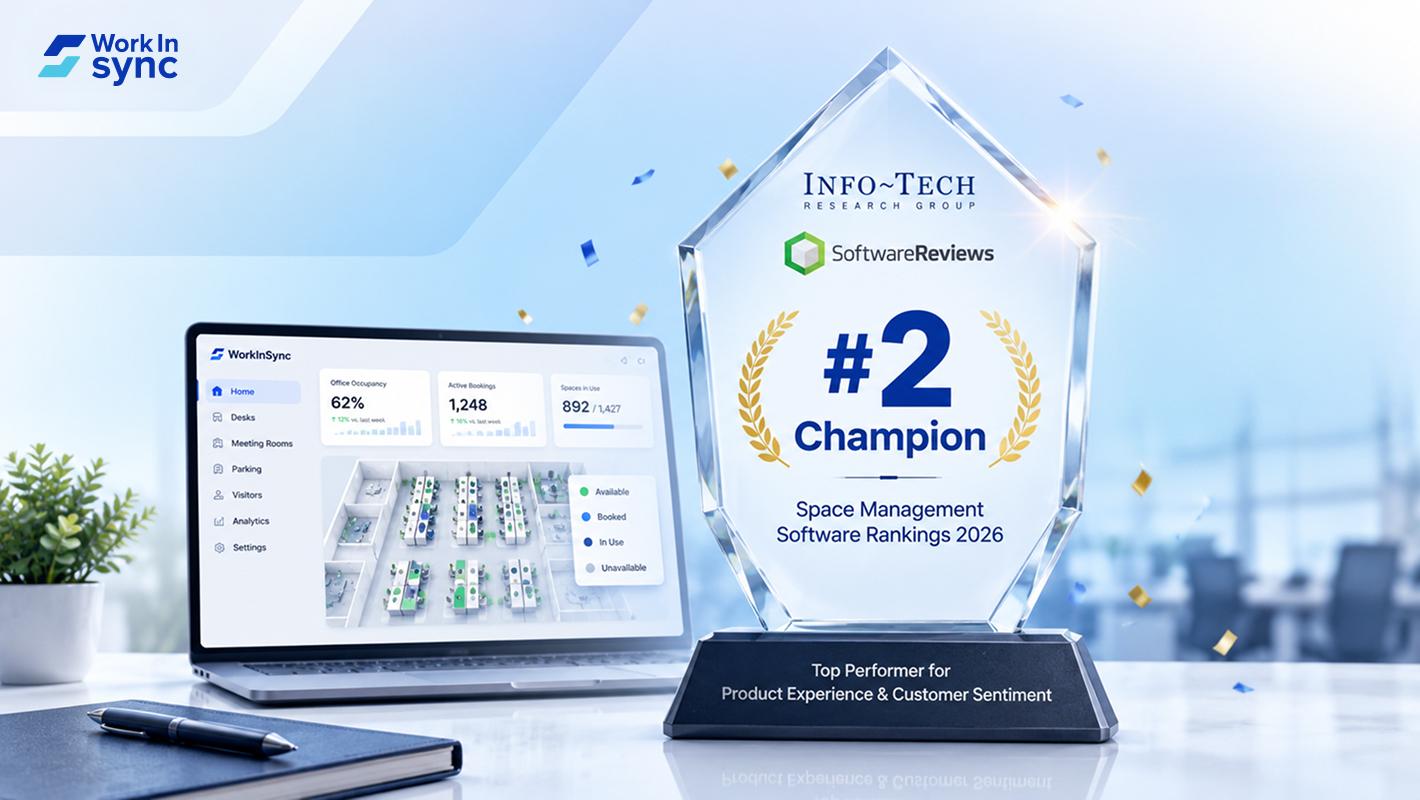
WorkInSync has been recognized by Info-Tech Research Group as a Champion in the 2026 Data Quadrant for Space Management, ranking #2, and as a Champion in the Emotional Footprint, ranking #2. Both awards are published on SoftwareReviews, Info-Tech's ratings platform, where rankings are built entirely from user feedback.

Sai Riddi
|
2 Min Read
Read More
 Desk Booking Software
5 June 2026
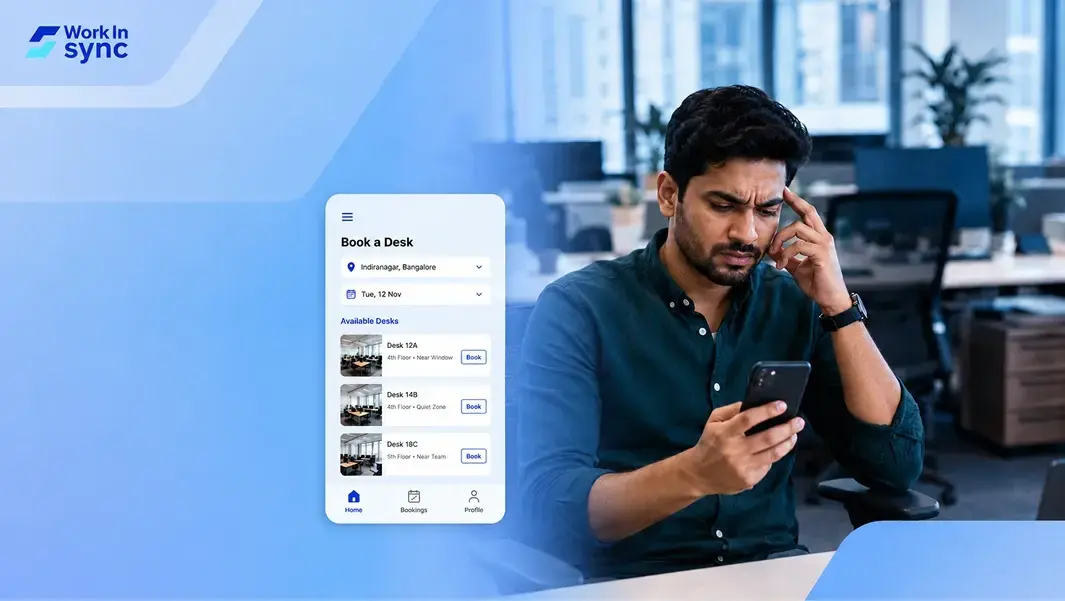
Let’s not pretend otherwise. Somewhere in your organization, a well-meaning IT or facilities team rolled out a desk booking system. There was a demo. Someone said “seamless.” There may have been a slide with the word “frictionless” on it. Leadership nodded. Procurement signed off. And then employees quietly went back to texting each other on […]
Ujjwal Trivedi
|
6 Min Read
Read More