
 Workplace Management
24 September 2026
Best Workplace Management Software in 2026: 6 Tools Compared
Compare six workplace management platforms. See what each is suited for and how to choose the right fit in 2026.

Deesha
|
4 Min Read
Read More

Key Takeaways
Workplace data helps improve employee experience by identifying real friction points across commute, space, and engagement.
Combining behavioral, operational, and perceptual data gives a complete view of how employees actually work and feel.
Tracking commute, space usage, meetings, and sentiment helps uncover gaps that impact productivity and satisfaction.
Solutions like WorkInSync enable real-time tracking of workplace data through bookings, usage patterns, and centralized visibility.
Analyzing data by segments like role, location, and days helps identify concentrated problem areas.
Prioritizing issues based on impact, prevalence, and ease of action ensures efficient resource allocation.
Running pilots and experiments before scaling helps validate what actually improves employee experience.
Real-time dashboards, reporting, and iterative decision-making make improvements scalable, repeatable, and measurable.
You can improve employee experience at scale by turning workplace data into clear, targeted actions that remove friction across employee commute, workspace, and engagement. Use data from what people actually do, like commute patterns, space usage, and feedback, to spot pain points and prioritize fixes that move the dial for many employees at once.
Start by collecting the right signals, analyze them to find consistent gaps, and apply repeatable interventions so improvements spread across teams and locations. This blog shows which metrics matter, how to interpret them, and how to convert insights into scalable changes that reduce churn, boost productivity, and strengthen culture.

You can’t improve what you don’t measure. Data gives you objective signals about how work actually happens, not just how people say it happens.
Quantitative metrics like eNPS (Employee Net Promoter Score), turnover rates, tool usage, and collaboration patterns reveal trends across teams and time. These let you spot systemic issues early and prioritize interventions where they will move the needle.
Qualitative inputs remain important, but they’re incomplete alone. Surveys and interviews provide context about why people feel a certain way, while behavioral and operational data validate and scale those insights.
Use a mix of metrics for balance:
Behavioral data (calendar patterns, app usage) to see work habits.
Operational data (performance, support tickets) to link experience to outcomes.
Perceptual data (surveys, interviews) to capture sentiment and meaning.
Data helps you target resources efficiently. Instead of guessing which teams need support, you can allocate coaching, tooling, or process changes where metrics and narratives align.
When you combine rigorously collected data with human-centered interpretation, you create repeatable, evidence-based improvements that scale across the organization.

Track commute patterns to understand how travel affects punctuality, stress, and remote/hybrid choices. Capture average commute time, mode of transport, and peak arrival windows to plan flexible start times and parking or transit benefits.
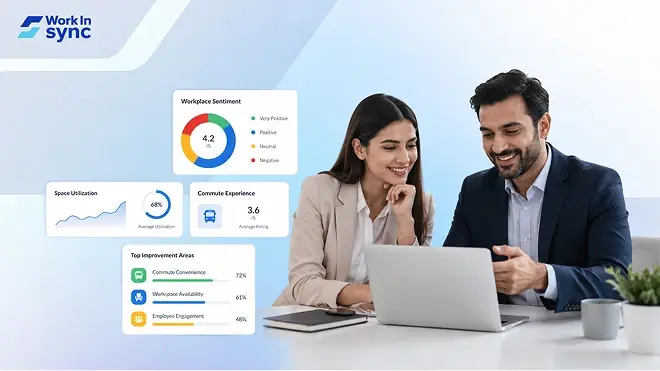
Measure space usage with clear, comparable metrics: office occupancy, office space utilization, and sharing ratio. Occupancy tells you how many people are present and utilization shows how often desks and rooms are actively used. The sharing ratio reveals how many people rely on each resource. Using workplace management tools like WorkInSync, this data can be captured through bookings and usage patterns, making it easier to track without additional effort. WorkInSync also helps consolidate this data in real time, giving teams a clearer view of daily movement patterns without manual tracking.
Monitor meeting and collaboration signals to see whether spaces support focused work or teamwork. Count meeting room booking volume, average length, and no-show rates, and pair these with room feature usage (AV, whiteboards). These signals reveal mismatches between design and behavior.
Collect engagement and sentiment metrics to connect environment changes with employee experience. Combine pulse surveys, NPS-style questions, and anonymous feedback. This helps you link physical changes to morale and productivity.
Start by defining what “good” looks like across the three dimensions that a workplace covers for employees: commute, space, and in-office experience.
Pick a focused set of outcomes such as desk utilization rate, commute no-show frequency, parking space conflicts, or even commute satisfaction and track each consistently so comparisons become meaningful over time.
WorkInSync’s real-time dashboards surface these signals automatically, drawing from bookings, check-ins, and usage patterns rather than requiring manual data collection. This means gaps appear as they form, not weeks later in a quarterly report
Segment your analysis to find where friction is concentrated. For example:
By day of week: If desk bookings spike on Tuesdays and Thursdays but no-shows stay high on Mondays, that signals a mismatch between stated intent and actual behavior of the employee.
By floor or zone: If one floor consistently shows low utilization while another is overbooked, an interactive floor plan and occupancy tracking can pinpoint the imbalance and guide reconfiguration.
By team or function: If a specific team repeatedly can’t find adjacent desks or collaborative spaces on their in-office days, neighborhood booking tools can be used to reserve zones for them in advance.
Prioritize gaps by impact and fixability.

Improving employee experience at scale requires more than one-off fixes. You need a repeatable process that moves from data to decision to measurable change
Start with space: Desk booking and room reservation data shows exactly which resources are in demand and which go unused. If meeting room no-shows are high, auto-release rules would help free up rooms in real time. If certain desk clusters are always overbooked, assign desks to teams zone-wise to reduce daily friction without requiring employees to compete for space each morning.
Then address the commute: Transport preferences and trip patterns reveal where the real pressure points are. If a large portion of employees arrive in the same window but parking is undersupplied, staggered allocation can reduce conflict. You can also support flexible start times or additional remote days on peak-traffic days. Sometimes letting employees shift their arrival time by 20-30 minutes can also create a huge difference.
Layer in feedback: Quick sentiment signals tied to specific in-office experiences help connect physical changes to how employees actually respond. Reconfiguring a floor or adding a quiet zone means little if you don’t know whether it landed.
Pilot before scaling: Test changes in one team or location first. Comparing pre and post-change utilization alongside feedback scores shows whether something worked before you commit to rolling it out broadly.
Operationalize with clear ownership: Assign owners for each metric, like a facilities manager for space utilization, an HR lead for engagement signals and set a regular reporting cadence. When everyone knows which number they’re responsible for moving, insights stop sitting in dashboards and start driving decisions.
You can scale meaningful improvements by treating workplace data as a strategic asset. Use data to reveal patterns, test interventions, and measure impact over time. Platforms like WorkInSync bring this together through real-time dashboards, structured reporting, and centralized data, helping teams move from scattered insights to clear, actionable decisions.
Adopt iterative cycles: hypothesize, test, measure, and adapt. Small, measured changes let you scale what works and stop what doesn’t without large upfront costs.
By embedding data into routine people decisions, you make improvements repeatable and transparent. That approach increases employee engagement, reduces friction, and strengthens organizational performance over time.
 Workplace Management
24 September 2026
Compare six workplace management platforms. See what each is suited for and how to choose the right fit in 2026.
Deesha
|
4 Min Read
Read More
 Announcement
13 August 2026
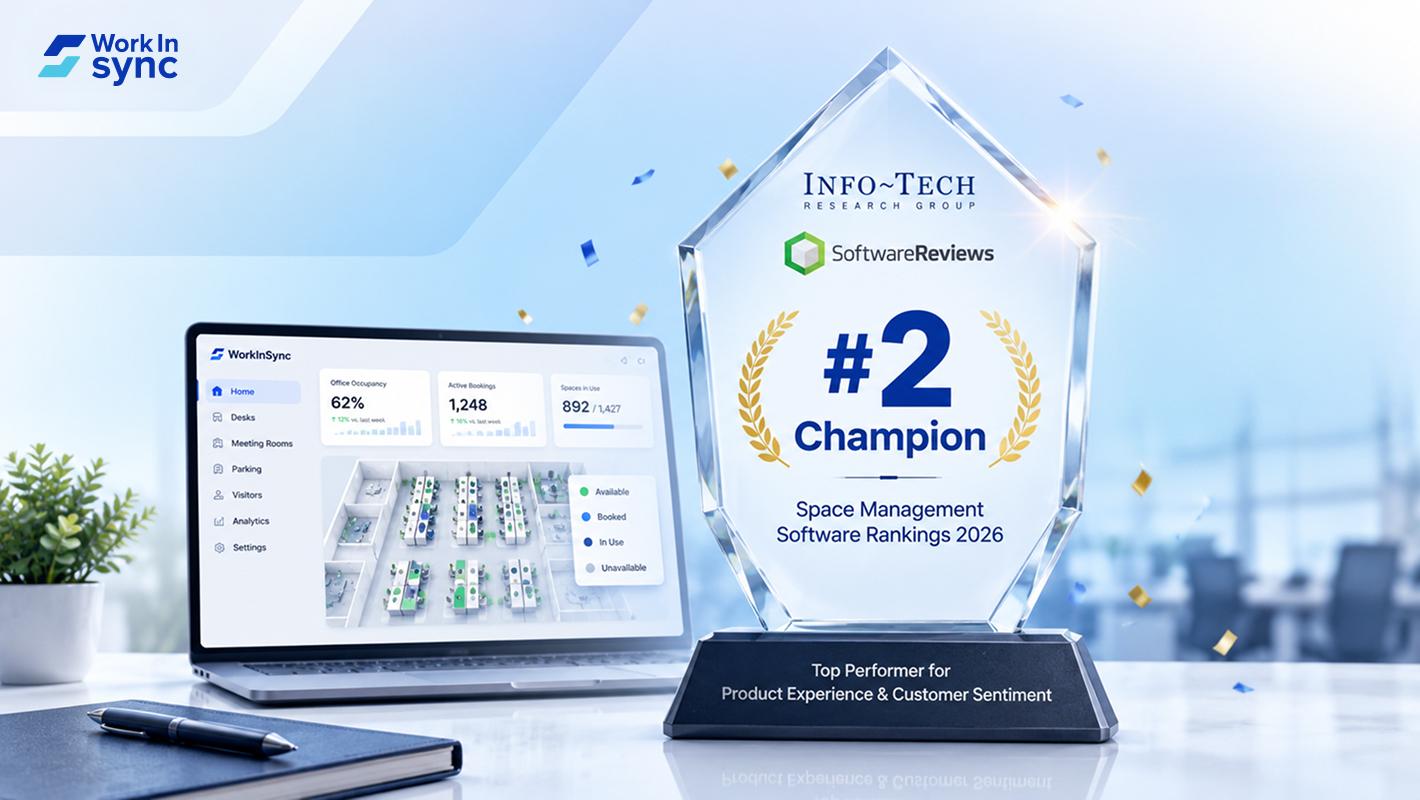
WorkInSync has been recognized by Info-Tech Research Group as a Champion in the 2026 Data Quadrant for Space Management, ranking #2, and as a Champion in the Emotional Footprint, ranking #2. Both awards are published on SoftwareReviews, Info-Tech's ratings platform, where rankings are built entirely from user feedback.
Sai Riddi
|
2 Min Read
Read More
 Desk Booking Software
5 June 2026
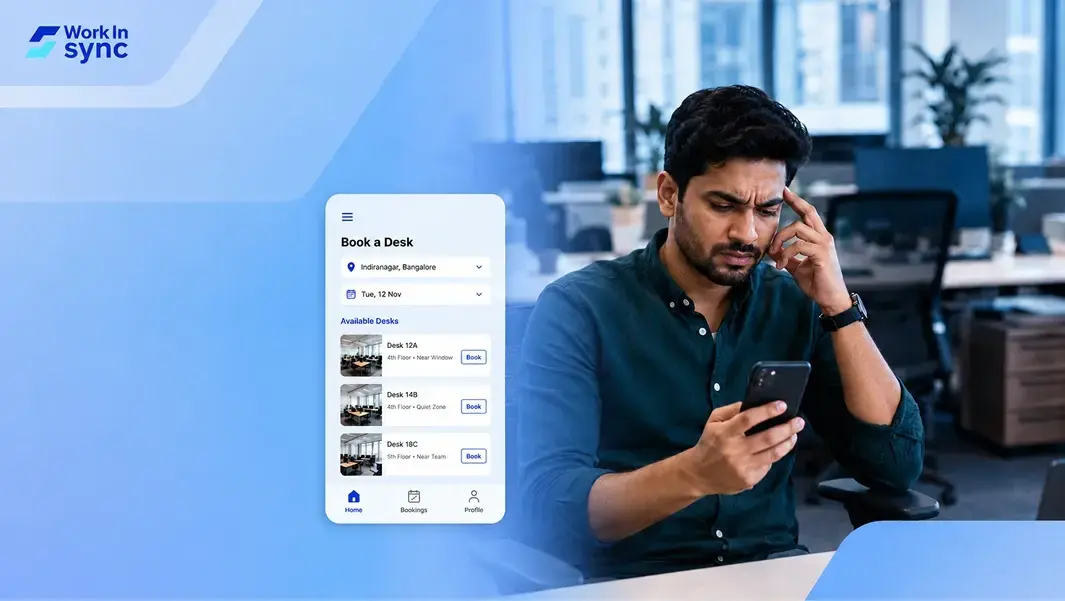
Let’s not pretend otherwise. Somewhere in your organization, a well-meaning IT or facilities team rolled out a desk booking system. There was a demo. Someone said “seamless.” There may have been a slide with the word “frictionless” on it. Leadership nodded. Procurement signed off. And then employees quietly went back to texting each other on […]

Ujjwal Trivedi
|
6 Min Read
Read More