
 Workplace Management
24 September 2026
Best Workplace Management Software in 2026: 6 Tools Compared
Compare six workplace management platforms. See what each is suited for and how to choose the right fit in 2026.

Deesha
|
4 Min Read
Read More

Key Takeaways
Returning to the office requires focus on three areas: policies & protocols, technology, and perception of safety.
Form a pandemic support team with cross-functional leaders to plan, implement, and maintain safety measures.
Update sick leave policies to be flexible, cover family responsibilities, and avoid requiring doctor’s notes.
Provide transport allowances to reduce public transport use and implement staggered shifts for reduced office density.
Enforce social distancing through desk spacing, adjusted transport schedules, limiting common area access, and avoiding in-person meetings.
Introduce safety protocols including pre-entry screening, voluntary symptom reporting, contact tracing, and thorough sanitization.
Use technology for collaboration (video conferencing, collaboration tools), social distancing (desk/room/transport booking, team planners), and sanitization (HEPA filters, UV systems, contactless access, smart HVAC).
Build perception of safety with visible workspace changes, on-site communication, and transparent cleaning efforts.
Follow CDC and OSHA guidelines for compliance in reopening offices.
Although we might still be some time away from corona fading into history, the silver lining is here. With the vaccines comes hope. It’s time to gear up, quite literally, for a return-to-office.

Returning to the workplace wouldn’t be easy for more than one reason. For one, life ranks higher than work in the larger scheme of things. Therefore, it would be naïve to think a group email can bring back people to work. Nothing short of a well-planned and organized effort will work. It would be best if you plan, prepare, communicate, and convince people to return.
We present to you a practical guide that will help HR and workplace/facility managers. Starting from focus areas, we detail out one step at a time. Here we go.
A transition kicks up a lot of dust. Things that matter and that don’t get mixed up, making prioritization difficult. To avoid it, we need to separate the wheat from the chaff for a more organized effort. At a macro level, a transition back to work would involve three focus areas:
The first thing on the to-do list of HR and workplace managers is to create a dedicated pandemic support team with members from various functions. This team would function as the central node for planning and implementing a COVID19 workspace policy and protocol.
Managing the implementation of safety protocols will not be possible without technology. It would help reduce dependence on human effort and presence at workspaces. From maintaining social distancing to housekeeping, technology can ensure adherence to the safety guidelines.
Fifty-one percent of 1000 people surveyed by PWC cited fear of getting infected as the reason for not returning to work. When you plan to bring back people to work, the perception of safety is as important as the measures in place. If organizations fail at creating it, the back-to-office efforts might not yield the desired result.
Let’s explore each one of these in greater detail.
Policy and protocols are central to your return to office program. An essential component of policy creation and implementation is a dedicated pandemic support and response team. Ideally, it must include leaders from various functions and business teams.
Your pandemic support team will not just serve as an advisory agency but as a team that implements and maintains the safety protocols. It needs to have a budget and resource allocation similar to any other business function. It also needs to be empowered to make purchase decisions for protective gear, equipment, and technology as and when required.
The starting point for your post-pandemic return policy has to be the CDC’s employer information for office buildings. All workplace and HR managers need to be conversant with these guidelines. Here are some of the salient points from the guidelines:
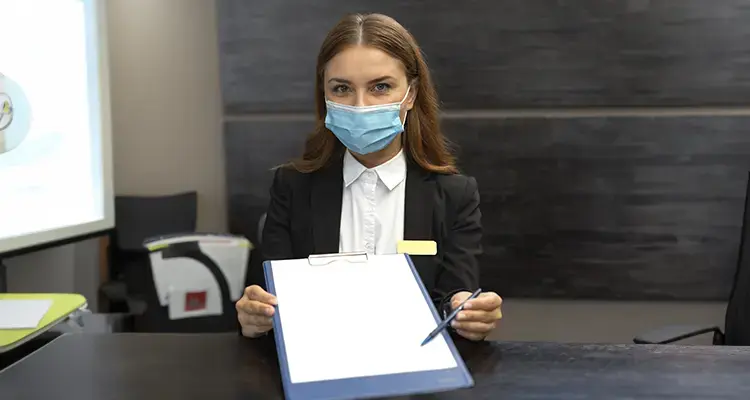
Revisit your sick leave policy to make it non-punitive and flexible. You also need to account for leaves required for familial responsibilities like taking care of family members or childcare due to school closure
It is also advisable to extend it for employees who currently aren’t eligible under the Family and Medical Leave Act. In fact, make special provisions for those who have exhausted their sick leaves
Account for the fact that visiting a health facility for doctor consultation may not be feasible. So, even for non-COVID leaves, do not insist on a doctor’s note
If employees use public transport for their daily commute or work-related travel, provide an allowance for individual transport. It would reduce the risk of exposure
Have staggered work shifts. You may have to rework your attendance policy and make additional provisions for splitting work hours between home and office to reduce the time at the office

Implement social distancing beyond maintaining distance between workstations
If you provide transport facilities, rearrange pick-ups and drop-offs to have minimum people on board
Limit access to common areas such as the cafeteria through staggered break timing
As far as possible, avoid in-person group meetings. For occasional team huddles, prefer open spaces to closed ones
Limit the number of people allowed in elevators to have adequate distance between the passengers
Implement pre-entry screening for all employees, contractors, and visitors. Please note that records of such information may qualify as medical records under the Access to Employee Exposure and Medical Records Standard (29 CFR 1910.1020), which has regulatory and compliance requirements
Encourage and facilitate voluntary reporting for employees who develop or exhibit COVID symptoms at work. Have a clearly laid out exit and transport plan in such cases
Sanitize work desk, equipment, and common areas used by infected employees
Implement contact tracing to limit transmission
Other employees who have come in contact to self-quarantine and self-monitor for symptoms
The nature and scale of changes for a safe return to office demand the application of technology. Workplace managers need to include technology and define its scope at the planning stage itself. Tech interventions could be at various levels, depending on your requirement.
Even as people return to work, minimize in-person communication using tech for collaborating
Use video conferencing tools for routine meetings
Use collaboration tools, like Slack and Teams, for asynchronous communication in tasks that do not require real-time interaction
Desk booking/seat blocking applications will help effective social distancing.
Conference room booking – Based on the number of participants, a conference room booking application can recommend a space big enough to avoid crowding
Office transport booking – Using it can help maintain social distancing within vehicles. It can also help people avoid queuing up for transport, significantly decreasing the transmission risk
Team planner – This piece of software can help you limit people density at any given point in time
High-efficiency particulate air filters and ultraviolet germicidal irradiation for better air cleaning and inactivating airborne virus, in line with industry guidelines
Computer vision to identify areas that require cleaning and to monitor the frequency of housekeeping
Contactless access management to minimize exposure in common areas
Intelligent HVAC systems to detect air quality, occupancy and switch to outdoor air supply when required
Safety perception is as important as safety measures.
Communication to employees about requesting a return to the office needs to carry visible transformations of the workspace. You could include a video tour of the changes carried out at the entry, floor layout, common areas, tech additions, and so on.
As employees return, the changes must be visible and highlighted with display boards and other forms of on-site communications. Housekeeping, once hidden, has to be more visible. Inform employees of deep cleaning efforts that take place after work hours. To that effect, they should be discouraged from leaving personal stuff or memorabilia on their desk.
Deploy multiple forms and channels of communication to build confidence among employees about the safety measures in place. You could also use a few posters from CDC’s print resources.
Before you announce the return-to-office program, know that it’s going to come with a cost. A well-laid-out plan, and the right technology partner, can ensure a healthy ROI on every dollar invested. WorkinSync’s solutions are cost-effective and go a step beyond merely ensuring compliance.
You can also download a checklist of things to do when designing your return-to-office strategy.
From a compliance perspective, stay updated on guidelines and regulations in place for employers and office buildings. Here are links to a few resources that will help you prepare better.
 Workplace Management
24 September 2026
Compare six workplace management platforms. See what each is suited for and how to choose the right fit in 2026.
Deesha
|
4 Min Read
Read More
 Announcement
13 August 2026
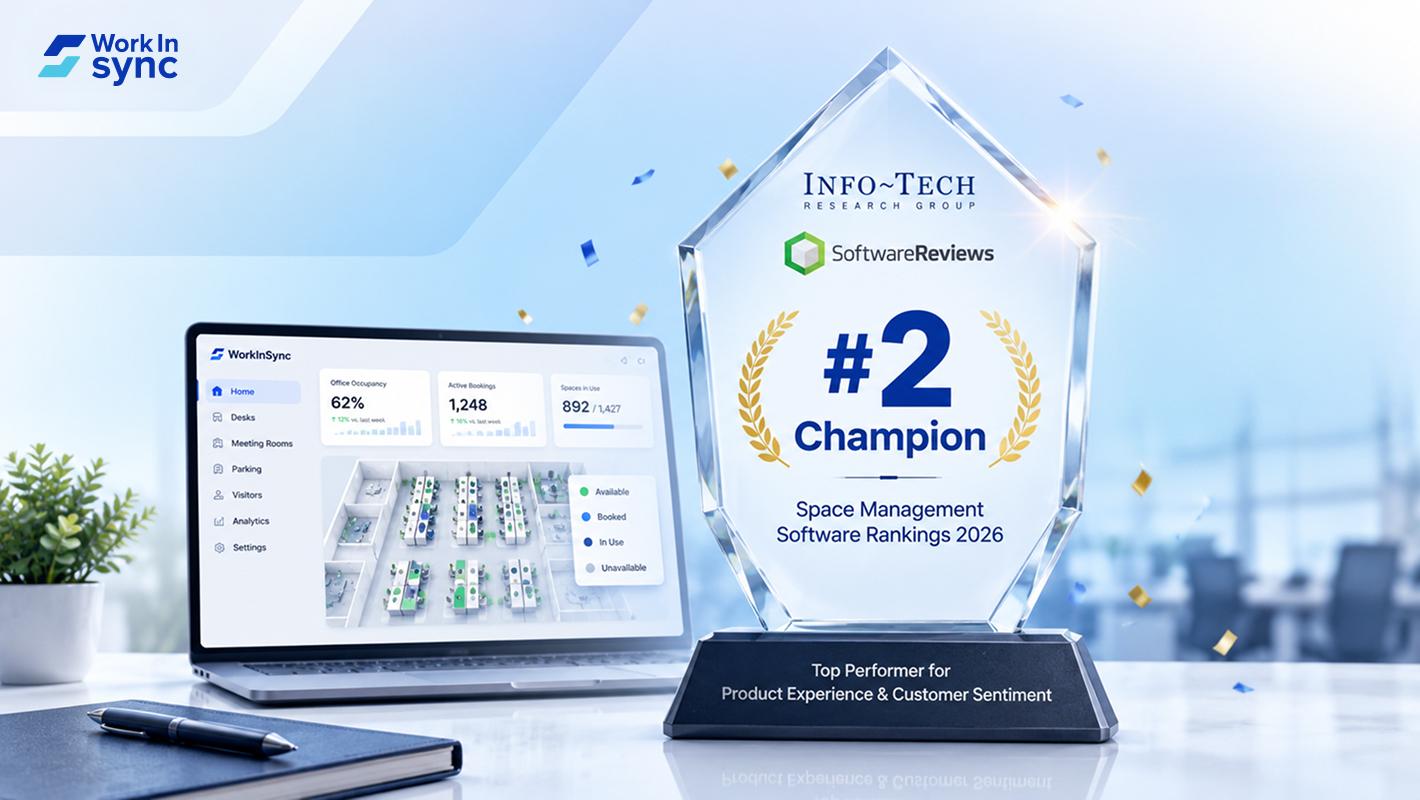
WorkInSync has been recognized by Info-Tech Research Group as a Champion in the 2026 Data Quadrant for Space Management, ranking #2, and as a Champion in the Emotional Footprint, ranking #2. Both awards are published on SoftwareReviews, Info-Tech's ratings platform, where rankings are built entirely from user feedback.

Sai Riddi
|
2 Min Read
Read More
 Desk Booking Software
5 June 2026
Let’s not pretend otherwise. Somewhere in your organization, a well-meaning IT or facilities team rolled out a desk booking system. There was a demo. Someone said “seamless.” There may have been a slide with the word “frictionless” on it. Leadership nodded. Procurement signed off. And then employees quietly went back to texting each other on […]

Ujjwal Trivedi
|
6 Min Read
Read More