
 Workplace Management
24 September 2026
Best Workplace Management Software in 2026: 6 Tools Compared
Compare six workplace management platforms. See what each is suited for and how to choose the right fit in 2026.

Deesha
|
4 Min Read
Read More

Let’s not pretend otherwise.
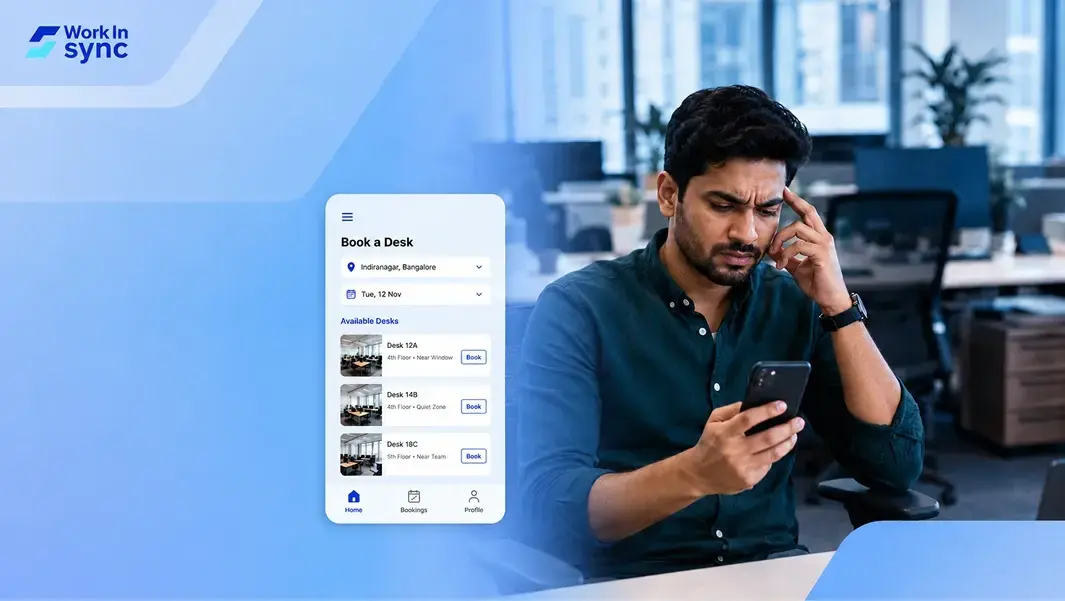
Somewhere in your organization, a well-meaning IT or facilities team rolled out a desk booking system. There was a demo. Someone said “seamless.” There may have been a slide with the word “frictionless” on it. Leadership nodded. Procurement signed off. And then employees quietly went back to texting each other on WhatsApp to hold their favourite desk by the window.
Sound familiar?
Enterprise software has a long, proud tradition of being built for the buyer, not the user. The person who evaluates and purchases the tool is almost never the person who has to use it every single day. So the software gets optimized for the demo: the feature checklist, the compliance tick-boxes, the integration slide.
What it doesn’t get optimized for is the engineer in Koramangala who just wants a quiet desk near her team on a Tuesday morning without filling out a form that feels like a tax return. Or the consultant in Canary Wharf who needs a meeting room before his 9am client call and doesn’t have ten minutes to navigate a booking portal on the Jubilee line. Or the sales manager in Uptown Dallas who drives forty minutes into the office only to discover the room he thought he’d booked was never actually confirmed.
This gap, between the buyer’s experience and the user’s experience, is where workplace tech goes to die.

Here’s a small thing that drives people absolutely mad, even if they can’t articulate why: the system doesn’t know who they are.
Not in a philosophical sense. Literally. They open the app on Monday and it asks for their name, their department, their floor preference, their default location. The same things it asked last Monday, and the Monday before that. Every session starts with a blank slate. No memory, no context, no sense that this person has been booking the same kind of desk in the same building for the last eight months.
Ask anyone working out of an office in Whitefield or Outer Ring Road, where the commute already costs them ninety minutes each way. They made that journey to be productive. Being asked to re-enter their details before they can even find a desk is not a minor inconvenience. It’s the kind of thing that makes people decide the office isn’t worth it.
The tool sees them as a transaction, not a person. And people, quite reasonably, resent it.

This is not a hypothetical. There are enterprise room booking systems in production today, in large and serious companies, where completing a single booking takes north of twenty clicks. Log in. Select building. Select floor. Select room type. Filter by capacity. Check availability. Select time. Confirm attendees. Add a meeting title. Accept the terms. Confirm. Get an email. Click the link in the email to confirm again.
A product team in SoMa, San Francisco books a room for a sprint review. Three people give up halfway and someone just grabs a phone booth. The sprint review happens in a phone booth meant for one person.
In London, a team in the City tries to book a client-facing space and ends up using a conference room that was reserved for a video call because nobody could figure out which rooms were actually free. In Bengaluru, a manager at a tech park off Sarjapur Road books a desk for her team of six, gets confirmation, and arrives to find half the floor locked because the booking system doesn’t talk to the access control system.
Nobody designed any of this to be cruel. It happened the way bad enterprise software always happens: one requirement got added, then another, then a compliance field, then a mandatory dropdown that nobody uses but Legal wanted. Death by a thousand reasonable decisions.
The result? People stop booking rooms properly. They hold spaces informally, ghost bookings pile up, the data becomes garbage, and the facilities team trying to make smart decisions about space utilization are working off numbers that bear no resemblance to reality.
You might think that larger companies, with more budget and more sophisticated IT teams, would have cracked this. They often have the worst of it.
In a big enterprise, the workplace experience problem sits somewhere between IT, HR, Facilities, and Real Estate. It belongs to everyone and therefore to no one. The employees who find the booking tool maddening are individually too small a voice to move anything.
Their frustration gets absorbed into the ambient noise of “change management challenges.” There’s always a bigger fire: a migration, a compliance audit, a restructure. And the fact that 40% of employees have quietly stopped using the desk booking software doesn’t make it onto any priority list.
This plays out the same way whether you’re running a hybrid policy for 3,000 people across Bengaluru and Hyderabad, managing a downtown Dallas office that went from five floors to two after the pandemic, or trying to get consistent utilization data across a London portfolio where three buildings run on three different systems. The tool limps on. Shelfware with a login page.
There’s a real irony here. Companies invest in workspace management software because they want data: utilization rates, peak occupancy, space planning insights. They want to make smarter decisions about real estate, which is usually the second-largest cost on the balance sheet.
A real estate lead in San Francisco trying to decide whether to renew a lease on two floors in the Financial District needs reliable occupancy data. She doesn’t have it, because half her employees book informally and the other half stopped using the system six months ago.
In Dallas, a facilities manager is being asked by leadership to justify the cost of a full floor in a Frisco campus. The booking data says 60% utilization. The actual number, based on badge swipes, is closer to 30%. The difference exists entirely because the booking tool is too painful to use consistently.
The digitization project succeeded on paper and failed in practice. And it failed for the most mundane, fixable reason: nobody made the tool easy enough to use.

It’s not complicated, even if it requires discipline to execute.
The tool needs to know who the employee is: their usual location, their team, their preferences, without asking them to repeat themselves every time. The developer in HSR Layout who comes in every Wednesday should be able to book her regular desk in four taps.
The team lead in London who always needs a room with a screen and a whiteboard shouldn’t have to specify that from scratch every week. The new joiner in Dallas shouldn’t need a colleague to walk them through the booking system on their first day.
It needs to surface relevant options, not an undifferentiated list of every room in every building globally. It needs to work in as few steps as possible, on a phone, without a tutorial.
It needs to respect the employee’s time. Because the employee’s time is, ultimately, the company’s time.
The facilities team deserves clean data. The real estate team deserves accurate utilization numbers. And the employee in Bengaluru who spent ninety minutes getting to the office deserves a booking experience that doesn’t make them wish they’d just stayed home.
That’s not a lot to ask. And yet, here we are.
WorkInSync is built on the premise that the people using the software matter as much as the people buying it. If your current tool is losing the adoption battle, it might be time for a conversation.
 Workplace Management
24 September 2026
Compare six workplace management platforms. See what each is suited for and how to choose the right fit in 2026.
Deesha
|
4 Min Read
Read More
 Announcement
13 August 2026
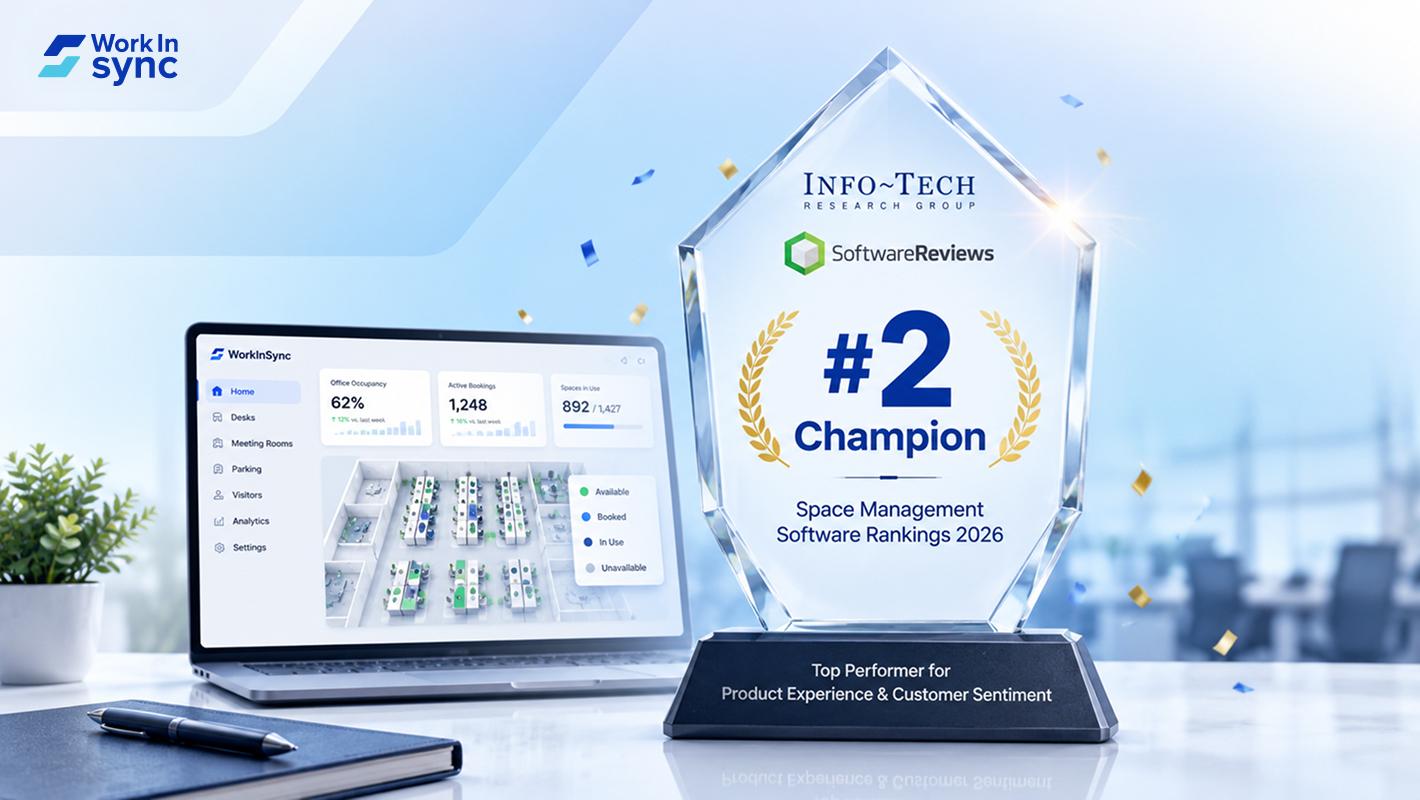
WorkInSync has been recognized by Info-Tech Research Group as a Champion in the 2026 Data Quadrant for Space Management, ranking #2, and as a Champion in the Emotional Footprint, ranking #2. Both awards are published on SoftwareReviews, Info-Tech's ratings platform, where rankings are built entirely from user feedback.

Sai Riddi
|
2 Min Read
Read More
Desk Booking Software5 June 2026
Let’s not pretend otherwise. Somewhere in your organization, a well-meaning IT or facilities team rolled out a desk booking system. There was a demo. Someone said “seamless.” There may have been a slide with the word “frictionless” on it. Leadership nodded. Procurement signed off. And then employees quietly went back to texting each other on […]
Ujjwal Trivedi
|
6 Min Read
Read More