
 Workplace Management
24 September 2026
Best Workplace Management Software in 2026: 6 Tools Compared
Compare six workplace management platforms. See what each is suited for and how to choose the right fit in 2026.

Deesha
|
4 Min Read
Read More


Key Takeaways
Hybrid work blends WFH comfort with WFO collaboration but risks chaos without intentional planning.
Employees may face envy, remote wanting exposure, on-site wanting flexibility, leading to friction.
Lack of clear intent in adoption can cause confusion, groupthink, and polarization.
Context switching between home and office can reduce productivity and delay adaptation.
Remote employees may face communication barriers and exclusion from in-person decisions.
Office presence can influence growth opportunities, reinforcing bias and inequality risks.
Managers face added responsibility to balance flexibility, inclusion, and perceived fairness.
Successful hybrid needs mindset shifts, top management advocacy, and patient change management.
Policies must address desk allocation, hiring diversity, attendance markers, and remote infrastructure.
Organizational structures should be reimagined to avoid “mostly-office” drift and power centers.
Technology can aid, but systemic workplace, process, and policy changes are essential for success.
The ongoing debate, whether you should work on-site or remote, has drawn eyeballs, no doubt. And people have found the middle ground, a very feasible option called the hybrid. People think they could marry both WFH and WFO and create something that could have the best of both worlds. When you cross-breed two species or processes or cultures – you are never sure whether you’d get the best traits or the worst. Creating a Hybrid workplace is a puzzle, or what Satya Nadella calls -‘ the hybrid paradox.’
Remote employees envy the exposure that on-site employees get. On the contrary, on-site employees envy the flexibility that remote employees get. Everyone says it’s inevitable. This blog is not a cliched comparison of WFO and WFH and how hybrid comes to the rescue. It’s also not about whether or not you should adopt the hybrid work model. Instead, this blog is about challenging the way we deal with the change happening around us.
Let us quickly summarise a few arguments that you’ve most likely come across about the Hybrid workplace model.

Greater work-life integration for employees: Employees now have a more acceptable alternative to choose from. They have more flexibility and better opportunities to take care of both work and personal schedules. You know, fit work in our lives and not the other way around.
Reduced cost of Real estate and Commute: Organizations can now scale the workplace infrastructure. Twice the employees for about the same number of desks – looks fantastic. Also, it can save costs for those who provide commute to their employees (majorly in Asia and Africa).
Attract and retain talent: What if the best talent for a particular domain is not available locally, or an existing employee wishes to settle elsewhere? Besides being another perk like flexi-hours for the local talent, a hybrid workplace can also open gates for hiring remote talent.
Hybrid is a heterogeneous mix of two different experiences. Offices offer collaboration, encourage organic learning, and reinforces culture, whereas remote work offers comfort, low distraction, and more productivity.
Bonus Read: Advantages of a hybrid workplace

Hybrid offers both but leaves the balancing act for the people to figure. It is likely a lot more complicated than what meets our collective imagination as of now.
First, we have to realize that we aren’t evolving into it; we are drifting towards it, fully aware but mostly without solid intent. Unlike companies like GitHub that went remote and got employees to sign up for this environment, most organizations currently deal with a vast employee base that hasn’t volunteered for this paradox. They’ve seen enforced work from the office and executed work from home (during the pandemic). They’re probably excited by the flexibility that a hybrid workplace might bring, but have they signed up for the confusion and chaos? Clearly not. It will mostly catch them unaware.
What happens in case of confusion? People try to go back to what previously worked. In this case – we know both remote and office have worked well. One has performed better than the other for most of them – and here comes the friction.
Who decides which employee has to be remote and which one has to be in office? Even if employees have complete flexibility, how’d they determine what’s most convenient and productive for them and their team? People follow groupthink. They are likely to follow the most influential person in the group. Very quickly, they’d all experience polarization and chaos.
The initial chaos is likely to settle down in some time. However, what follows is even more unnerving. A new set of issues will emerge.
Context switching: Hybrid may introduce a constant feeling of impermanence. As humans, we love permanence. When we used to go to the office, we introduced home-like attributes to the place. When we were forced to work remotely, we quickly tried to adapt a corner of our home to be more office-like. When we have to constantly switch between the two with 2/3 days in office kind of policy, will it be the most conducive for our productivity? There are inherent differences in the way you operate in the office versus you operate at home. It would take the majority a long time to adjust to the “new way,” – and they might experience productivity loss till then.
Communication issues: Remote team members may not feel included and will face constant communication barriers. It is hard for people in the office to go out of their way to have those other people in the call – they’d find it easier to discuss and decide with who’s in office and inform others later. It’s hard for someone to know who’s expected in a meeting in person and who’s attending virtually. And even if it is enabled, it would be hard to avoid cross-talks and information loss for remote parties.
Bias/Inequality/Discrimination might be reinforced: Exposure is directly proportional to employees’ growth prospects in most organizations. Being “seen” has always been important. The time spent in office might become an accidental measure of your sincerity towards work and dedication towards the organization’s goals. That’s already a red flag. In addition, some organizations also fear that inequality and bias towards minorities (based on color, race, or gender) might increase.
Bonus Read: Challenges of Hybrid Workplace
Overwhelming for Managers: It is easy to guess that it will be psychologically draining. Managers might find it hard to include “inclusion” as an additional layer of responsibility forced by the hybrid workplace. They will have to constantly pursue arrangements to ensure that the promise of flexibility is achieved and they’re able to take care of the “convenience” of the employees. At the same time, it needs to be perceived as fair by employees choosing to work from the office. Managers also need to ensure that the communication barriers are minimized.
As you can see, the hybrid workplace can bring a lot of chaos, friction, and second-order effects. So then, is it still feasible? Yes, with proper implementation and adoption, the benefits will outweigh the effort in due course. However, it’s not going to be simple; a “workplace committee can’t handle it,” and it can’t be outsourced to technology. It would need a shift in mindset, a strong push from the top, and patient change management. Here are a few thoughts:
Workplace allocation: The top brass of one of our clients was actually in the news for letting go of their dedicated desks. Like the HSBC CEO, the top management at all organizations will need to adopt new ways and create a strong push for desk-hoteling/hot-desking. It would require a mix of technology, policy changes, and the clear intent of the management.

Hiring Policy: If you continue to keep hiring local – your model will eventually become “mostly-office.” The organizations would need to let go of their regional hiring bias and expand their scope to remote employees. The more you accept the diversity (remote versus in-office), the better are your chances of adopting Hybrid properly.
Recommended Reading: Recruiting in a hybrid workplace
HR Policy: Would it still make sense to allow the biometric/RFID-based entry systems to measure your employees’ “in-office” hours? Is attendance even relevant – what’s the new marker of attendance when many folks are attending remotely? How’d you capture it? Also, who takes care of the infrastructure and cyber-security at remote locations? Finally, would remote employees need a different set of privileges, remuneration policy, and leave structure? How’d you keep it fair?
Workplace policy: How would you ensure employees can switch their context as quickly as possible? How open or restrictive the office premises will be for remote employees? In case of desk hoteling, how far in advance would employees need to plan? As for hoteling, how’d you handle the high variability of usage?
Organization structure: The organization’s hierarchy and structure must be re-imagined to support the hybrid workplace model. You can’t reduce the offices and encourage key decision-makers to gravitate towards a “headquarter.” How will you reorganize your team to ensure no political power centers are emerging?
Technology like WorkInSync can help answer a lot of the questions that I’ve highlighted above. But, technology alone won’t cut. You can avoid hybrid becoming “mostly-office” if you also appropriately evolve your agile workplace. The workplace, process, and systems all need to develop steadily and with the people involved.
The answer depends a lot on how you intend to go hybrid. Are you ready to reimagine your org structures? Redesign the offices to give your employees a cohesive, “designed” experience? Are you ready to upgrade your policies and let go of your biased preferences? Are you prepared for intentional systemic changes that might need you to consider all employees as “remote employees” at all times?
To summarize, is going Hybrid an intentional plan or an inevitable compromise for you? The answer to that question will determine the “future of work” for your organization.
Stay on top of the latest hybrid workplace trends. Subscribe to our blogs now.
 Workplace Management
24 September 2026
Compare six workplace management platforms. See what each is suited for and how to choose the right fit in 2026.
Deesha
|
4 Min Read
Read More
 Announcement
13 August 2026
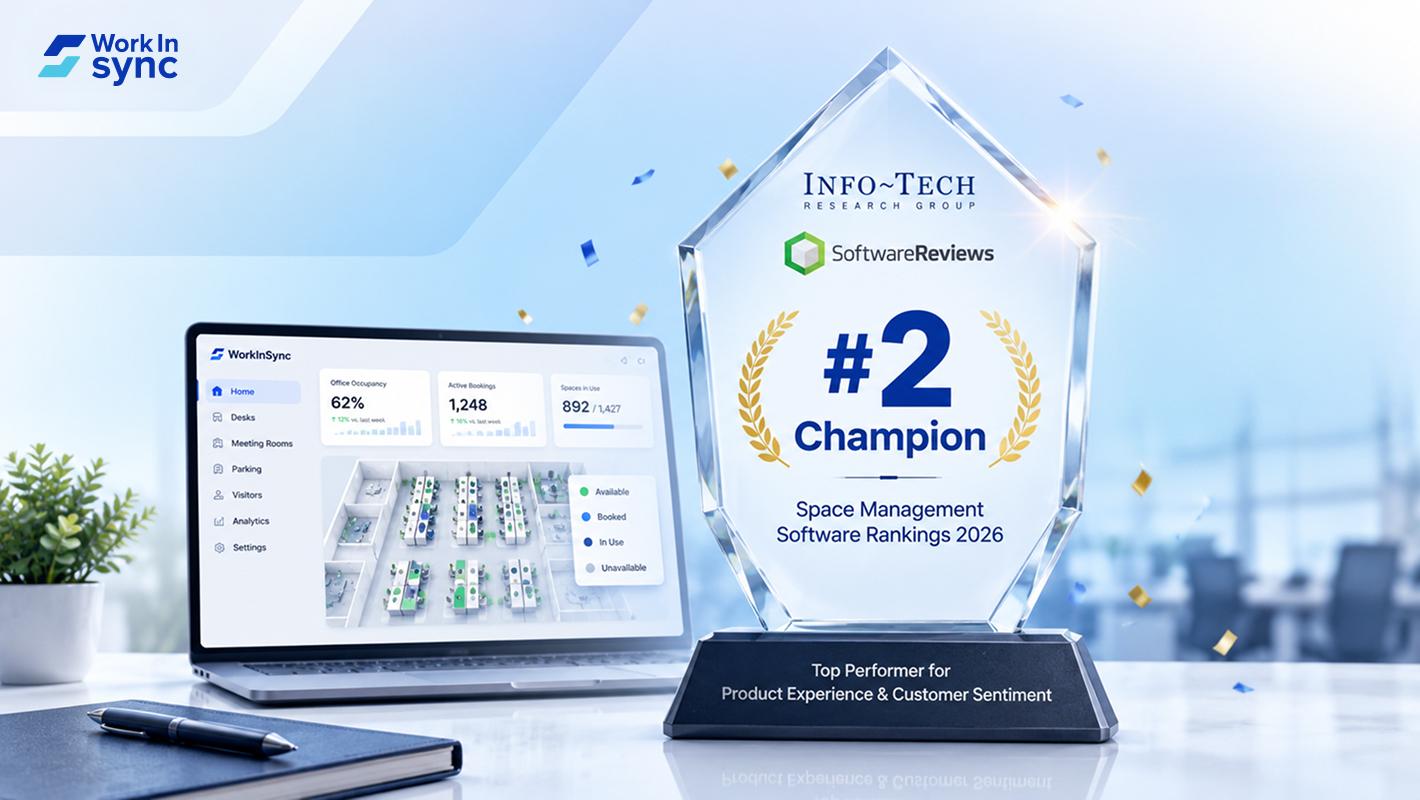
WorkInSync has been recognized by Info-Tech Research Group as a Champion in the 2026 Data Quadrant for Space Management, ranking #2, and as a Champion in the Emotional Footprint, ranking #2. Both awards are published on SoftwareReviews, Info-Tech's ratings platform, where rankings are built entirely from user feedback.

Sai Riddi
|
2 Min Read
Read More
 Desk Booking Software
5 June 2026
Let’s not pretend otherwise. Somewhere in your organization, a well-meaning IT or facilities team rolled out a desk booking system. There was a demo. Someone said “seamless.” There may have been a slide with the word “frictionless” on it. Leadership nodded. Procurement signed off. And then employees quietly went back to texting each other on […]

Ujjwal Trivedi
|
6 Min Read
Read More