
 Workplace Management
24 September 2026
Best Workplace Management Software in 2026: 6 Tools Compared
Compare six workplace management platforms. See what each is suited for and how to choose the right fit in 2026.

Deesha
|
4 Min Read
Read More
Key Takeaways
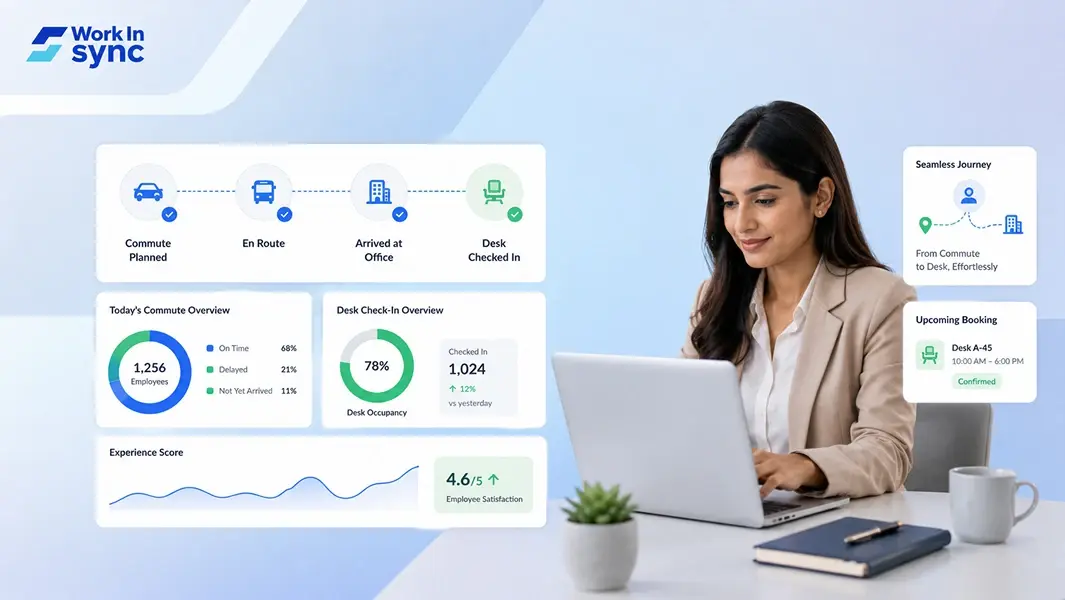
The commute-to-desk transition is a critical touchpoint that directly impacts employee experience and daily productivity.
Workplace data from integrated transportation and office management systems reveals friction points in hybrid work schedules.
Connecting commute and in-office arrival processes creates measurable improvements in employee satisfaction and workplace efficiency.
The daily commute and office arrival shape how employees feel about their entire workday. When these touchpoints create friction, productivity and morale suffer before work even begins. Employee experience journey mapping reveals that the transition from home to desk represents a critical moment that matters in your workforce’s day.
Organizations increasingly rely on workplace data to understand what actually happens during hybrid workdays. You need visibility into both the commute experience and the in-office arrival process to create smooth transitions for your team.
Mapping the employee journey from departure to desk helps identify pain points you can address through integrated solutions. When you connect transportation and workplace management systems, you transform disconnected touchpoints into one seamless experience that supports employee satisfaction and operational efficiency.
The employee journey begins long before your team members arrive at their desks. Research into commuting characteristics reveals how commute time, quality, and predictability directly affect worker wellbeing and performance.
Key commute factors impacting your workforce:
Commute duration and reliability
Transportation mode choices
Stress levels during travel
Arrival state and readiness
When employers are not meaningfully engaged with employee commutes a gap arises, that represents a missed opportunity in the employee experience journey.
Data-driven commuting solutions provide insights into commuting patterns that help you make informed decisions. You can transform this overlooked touchpoint into a competitive advantage by addressing transportation challenges before they drain productivity and morale.
Your hybrid workday doesn’t follow a universal template. Avoiding commute time remains the top reason employees choose hybrid arrangements, fundamentally changing how they structure their schedules.
Employee autonomy shapes the hybrid experience differently across organizations. Some companies let you choose your office days, while others mandate specific in-office schedules. This flexibility directly impacts your employee sentiment and daily planning.
Understanding your actual experience requires examining survey data and employee feedback. Organizations use pulse surveys and engagement surveys to track how hybrid schedules affect your productivity and satisfaction. Sentiment analysis from these tools reveals what works and what creates friction in your day-to-day routine.
Your hybrid reality includes:
Coordinating schedules with team members for collaboration days
Managing technology transitions between home and office setups
Balancing focused work time with in-person meetings
Navigating different workspace availability and booking systems
The data shows hybrid work benefits both companies and employees when implemented thoughtfully.
Employee journey mapping requires you to document the physical path your workers take from arrival to workspace. This journey map captures critical touchpoints like parking, building entry, security checkpoints, and elevator waits.
Start by identifying employee personas across different roles and schedules. A remote worker visiting quarterly experiences different moments that matter than daily commuters.
Track each interaction point systematically:
Building access and badge systems
Lobby waiting areas
Elevator capacity during peak hours
Hallway navigation to desks
Amenity locations (restrooms, kitchens)
Employee experience journey mapping helps you identify pain points in this routine. Long security lines, confusing wayfinding, or insufficient parking create friction before work begins. Your map should capture time spent, emotional states, and obstacles encountered at each stage.
MoveInSync automates employee transportation through AI-generated routing and intelligent scheduling. You get access to home-to-office cabs, fixed-route shuttles, and corporate car rentals managed through a single platform.
The system handles your daily commute without requiring manual bookings each day. Features like Shuttle Pass streamline transportation by eliminating repetitive reservation tasks.
Key capabilities include:
AI-powered routing that optimizes travel paths
Real-time tracking for enhanced safety monitoring
Automated billing to reduce administrative overhead
MoveInSync’s technology replaces spreadsheet-based coordination that previously required large teams. Your transport operations now run through centralized software rather than phone calls.
WorkInSync optimizes workplace experience by letting employees plan in-office days and book workplace resources in one unified platform. The system handles everything you need once you arrive at the office.
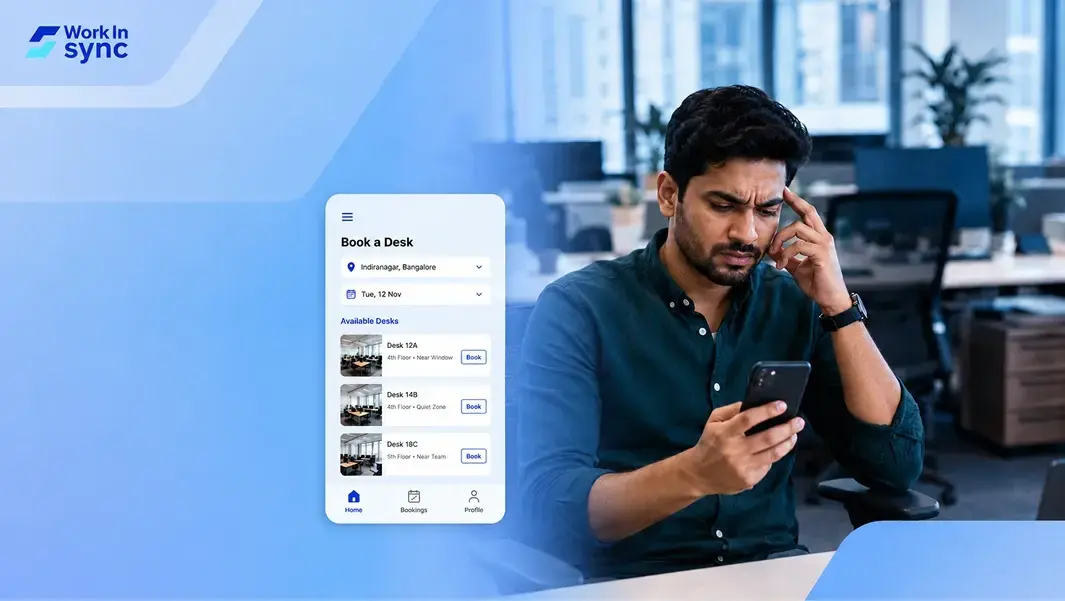
The platform provides flexi-desking, meeting room management, and parking coordination through a single app. You can book your desk, reserve conference rooms, and arrange parking before stepping into the building.
WorkInSync integrates with Microsoft Outlook, Teams, Slack, and Google Assistant, connecting your existing tools to workplace booking. This integration ensures your office reservations sync with your calendar and communication platforms.
The visitor management solution syncs guest arrivals with employee schedules and auto-generates passes. Your visitors receive notifications while hosts get timely alerts about guest arrivals.
MoveInSync and WorkInSync function as integrated platforms that manage both commute and workplace operations. The combination addresses your complete hybrid work needs in a single ecosystem.
You can access transportation, desk reservations, meeting rooms, parking, and meal bookings through one unified application. This door-to-desktop approach eliminates the need to juggle multiple systems for different workplace functions.
Key integrated features include:
Employee transport scheduling and route optimization
Desk and workspace booking
Meeting room reservations
Parking management
Visitor coordination
Safe reach verification
The platforms connect with your existing tools like Microsoft 365, Google Workspace, and Slack, maintaining workflow continuity. Your hybrid schedule planning becomes seamless when commute arrangements automatically align with office resource bookings for the same day.
Transform your workplace by implementing employee experience journey mapping today. Start by gathering workplace data across all touchpoints, from commute experiences to desk arrival.
Your immediate action plan:
Document current processes – Map every interaction employees have during their daily journey
Identify pain points – Use employee journey mapping tools to pinpoint friction areas
Prioritize improvements – Focus on high-impact changes first
Measure results – Track engagement metrics before and after implementation
Begin with a pilot program for one department. Test your improvements, collect feedback, and refine your approach. Once validated, roll out seamless employee experiences organization-wide.
Your employees deserve thoughtful, data-driven experiences. Take action now to build a workplace where every journey matters.
 Workplace Management
24 September 2026
Compare six workplace management platforms. See what each is suited for and how to choose the right fit in 2026.
Deesha
|
4 Min Read
Read More
 Announcement
13 August 2026
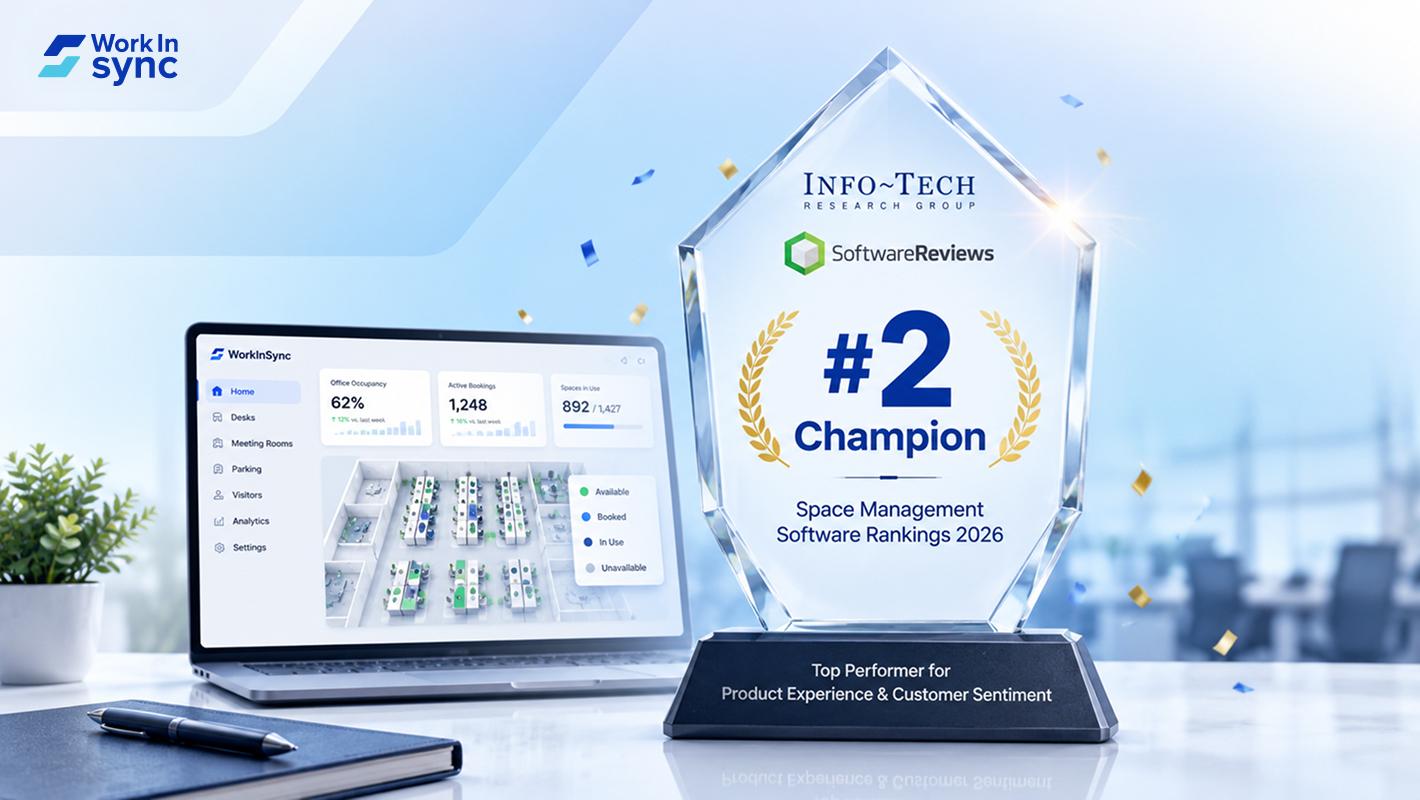
WorkInSync has been recognized by Info-Tech Research Group as a Champion in the 2026 Data Quadrant for Space Management, ranking #2, and as a Champion in the Emotional Footprint, ranking #2. Both awards are published on SoftwareReviews, Info-Tech's ratings platform, where rankings are built entirely from user feedback.
Sai Riddi
|
2 Min Read
Read More
 Desk Booking Software
5 June 2026
Let’s not pretend otherwise. Somewhere in your organization, a well-meaning IT or facilities team rolled out a desk booking system. There was a demo. Someone said “seamless.” There may have been a slide with the word “frictionless” on it. Leadership nodded. Procurement signed off. And then employees quietly went back to texting each other on […]

Ujjwal Trivedi
|
6 Min Read
Read More