
 Workplace Management
24 September 2026
Best Workplace Management Software in 2026: 6 Tools Compared
Compare six workplace management platforms. See what each is suited for and how to choose the right fit in 2026.

Deesha
|
4 Min Read
Read More


Key Takeaways
Proximity bias in hybrid setups can make remote workers feel invisible and undervalued.
Only 13% of employers are actively addressing fairness between remote and in-office employees.
Diversity, equity, and inclusion (DEI) are crucial for building a fair and balanced hybrid workplace.
Hot-desking and flexible seating can break down workplace hierarchies and encourage equality.
Equity ≠ equality: equity means giving each employee the tools they need to succeed, not just equal treatment.
Equity promotes cognitive diversity, shared vision, better engagement, and more innovative decision-making.
Companies like Unito use inclusive practices like recording meetings to support async collaboration and fairness.
To foster fairness, create space for informal interactions like mentorship, check-ins, and social bonding.
Rethink productivity policies: focus on outcomes over hours and ensure transparency in performance reviews.
Provide equitable access to tools and spaces, from ergonomic furniture at home to co-working subsidies.
Improve collaboration with the right software, clear video meeting norms, and equal access to resources.
Have you heard about “proximity bias” in a hybrid workplace? It is essentially a cognitive bias formed on the “out of sight, out of mind” principle. This can affect both workers and leaders poorly.
For instance, employees who’ve chosen to work from home could feel undervalued amid a lack of visibility. This is essentially how the proximity bias plays out and harbors feelings of “unfairness” among employees.
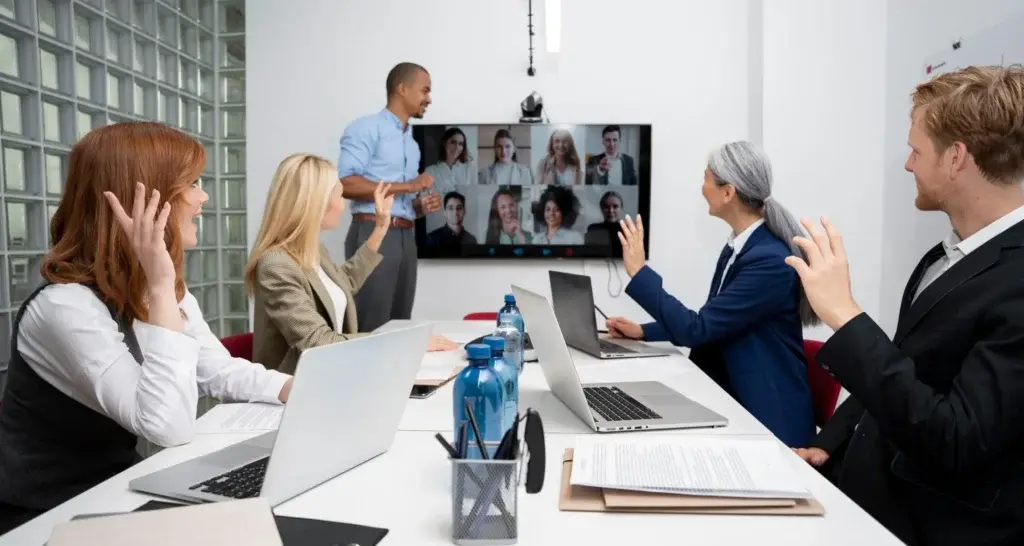
Problems arise when such biases go unchecked for a prolonged time. In a hybrid workplace setting, this can lead to disparities between co-workers. Yet, only 13% of employers are concerned about ensuring parity and maintaining fairness between remote and on-site workers.
Given the harmful consequences, how can you balance the scales for your hybrid workplace? Well, you work on the three constitutional pillars: diversity, equity, and inclusion.
Let’s explore!
Also Read: A Practical Guide to Designing a Hybrid Workplace

Talks about diversity, equity, and inclusion at the workplace have been gaining traction for years now.
Workplace diversity has a direct impact on company success. Research by Harvard Business Review revealed that diverse organizations are more likely to capture new markets and outperform competitors. This also translates to more significant opportunities and enhanced revenue for your business.
Besides, the disparity at the level of pay, resources, access to healthcare, etc., can leave workers feeling alienated and undervalued. This is essentially a recipe for employee dissatisfaction. Inevitably, this leads to employee attrition, especially for organizations relying on a hybrid workplace.
The “return to office” in a hybrid workplace has several nuances. This is because employees are returning from a different situation at home. Some might have children or elders to look after, while others might have safety concerns. Accommodating such employee concerns without malice is essentially where fairness lies.
Now, if you consider the hybrid workplace model, there are primarily two ways of functioning:
1. Depending on necessity/choice, employees work on-site on certain weekdays and remotely on others. The rotation and balance will differ at the organizational level and the hybrid workplace strategy implemented.
2. Some teams/members work entirely on-site like pre-Covid times, and others work from home based on the role.
Failing to address the fears of employees will only end up echoing a sentiment of preferential treatment they might be feeling.
On the brighter side, a hybrid workplace can give you a ready opportunity to create a fair work environment. For example, practices like hot-desking eliminate the “corner office” concept. It empowers workers to choose where they want to sit and work.
The onus of promoting such equitable practices are promoted by hybrid work models when implemented correctly.
Before you can transpire any change in your hybrid workplace, you must get rid of your prejudice.

When you correct yourself from your biases, you can set an example for your team. It is the first step towards promoting equity in your hybrid workplace. However, it would help if you didn’t confuse equality for equity.
While the two terms are often used interchangeably, there is a mountain of difference between the two. The former focuses on giving fair and equal treatment to every employee, without any discrimination or bias. The latter levels the playing field by providing the enablement, access, and resources they need to succeed.
As you can see, equitable practices, and not just equal opportunities, are essential to implement a fair hybrid workplace model. Also, to create positive employee experiences across employee designations and demographics.

Besides, with equity at the heart of your hybrid workplace model, you can also reap many tangible benefits for your business.
1. An equitable hybrid workplace enables cognitive diversity. This means you have more people thinking outside-of-the-box business solutions and driving the bottom line in effect. It also opens the space for varied decision-making to thrive and promotes employee engagement.
2. A diverse and equitable hybrid workplace encourages employees to work towards a shared vision. When everyone on the team shares the same goal, they feel a sense of purpose and value. This results in better performance and productivity.
Many organizations worldwide have already taken special provisions to foster workplace equity amid the new normal. Take the example of Unito. All the company meetings are conducted online and recorded for everyone to access to ensure fairness across levels. So, employees have the liberty to work asynchronously and don’t feel left out!
Wondering how you can do the same? Well, start by adopting policies, practices, and procedures designed purposefully for equitable hybrid workplace operations.
Consider the following practices to foster a more equitable culture for your hybrid workplace.

There are no “water cooler” moments in the virtual space and limited ones in a hybrid workplace owing to safety reasons. Without casual office conversations, many workers can feel a social disconnect. This can escalate to power imbalances and communication gaps if prolonged.
You could start a mentorship program for a more personalized onboarding of new hires. You can hold occasional get-to-know-your-colleagues informal meets for both your in-office employees and those who work remotely.
As a manager, you know how essential catch-up calls are in understanding employee sentiments. The pandemic has been brutal on everyone. So, consider extending a compassionate space where your co-workers can express freely about their likes, and dislikes.
Since a hybrid workplace has a geographically dispersed workforce, you will need to revisit your practices for measuring employee productivity.
Rather than relying on how many “hours” they work, you can try a more result-driven policy for performance reviews. Establish clear goals and objectives for both home-based and office-based workers and evaluate performance against those markers.
Doing so can also discourage an “Us vs. Them” culture among your hybrid workplace team. Moreover, it will create a fair progression path for everyone on the team regardless of their work location. However, no matter what changes you adopt, ensure complete transparency during the transition phase.
In a hybrid workplace, you’ll have workers operating from different work sites. Other than offices and their homes, they could also choose to work from spaces like coffee shops or co-working spaces. Providing equitable access to all such work modes without any ill-feeling can also go a long way in empowering employees. Furthermore, it is instrumental in creating a fair work environment.
You could offer ergonomics furniture to support their work from home. Additionally, you can provide subsidized membership for a co-working space to a chunk of your employees living nearby. In a similar vein, your in-office employees should also have the suitable space, tools, and tech. This will allow them to collaborate and engage virtually in a hybrid workplace set up.

Enabling effective collaboration between employees is perhaps the biggest challenge in a hybrid workplace environment.
According to a report by Gartner, 71% of HR leaders are more concerned about employee collaborations. After all, how employees engage and execute a goal together directly impacts innovation and productivity at work.
Here’s how to foster seamless collaboration for a hybrid workplace.
To ensure remote employees don’t feel like they’re working in silos, you should invest in sophisticated software designed for collaboration.
Create a set of guidelines and best practices for video-conferencing, focused on the intentional inclusion of the remote workers.
Make sure both remote and office-based workers have access to vital information and documents they need.
With proactive efforts, you can offer more room for effective collaboration, co-creation, and creativity.
A fair hybrid workplace will look different for different organizations. It will require a series of trial and error on your part.
Want to make a head start? Turn to WorkInSync, your one-stop digital solution for effective hybrid workplace management. Schedule a demo to experience the seamless implementation of the hybrid workplace.
Subscribe to our blog to know more about the latest developments in hybrid workplaces.
 Workplace Management
24 September 2026
Compare six workplace management platforms. See what each is suited for and how to choose the right fit in 2026.
Deesha
|
4 Min Read
Read More
 Announcement
13 August 2026
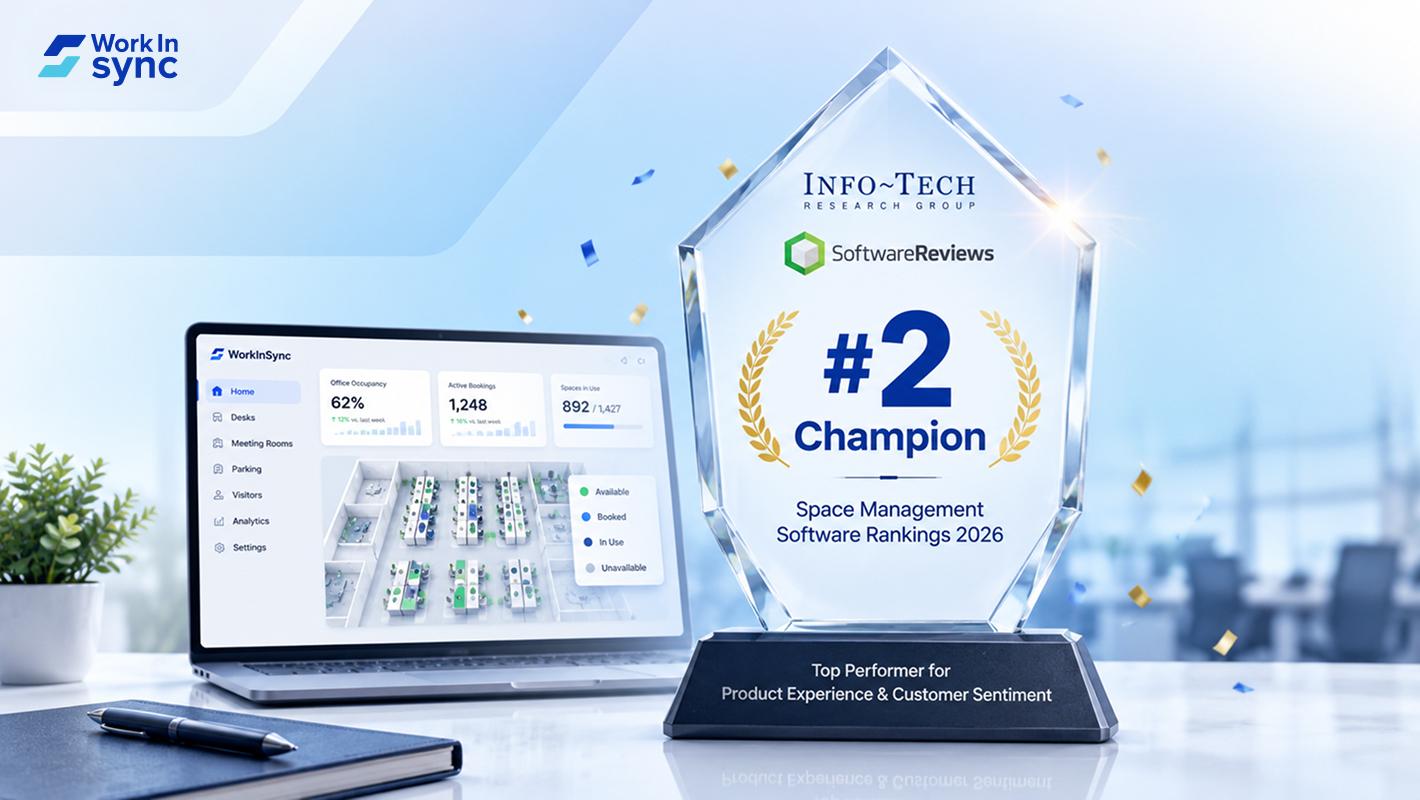
WorkInSync has been recognized by Info-Tech Research Group as a Champion in the 2026 Data Quadrant for Space Management, ranking #2, and as a Champion in the Emotional Footprint, ranking #2. Both awards are published on SoftwareReviews, Info-Tech's ratings platform, where rankings are built entirely from user feedback.

Sai Riddi
|
2 Min Read
Read More
 Desk Booking Software
5 June 2026
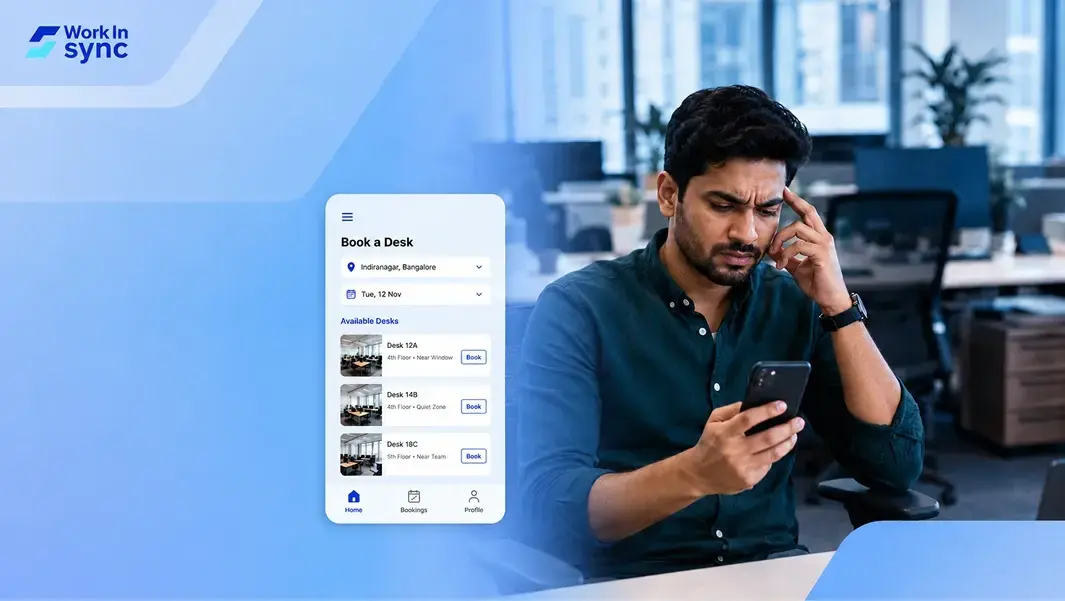
Let’s not pretend otherwise. Somewhere in your organization, a well-meaning IT or facilities team rolled out a desk booking system. There was a demo. Someone said “seamless.” There may have been a slide with the word “frictionless” on it. Leadership nodded. Procurement signed off. And then employees quietly went back to texting each other on […]

Ujjwal Trivedi
|
6 Min Read
Read More