
 Workplace Management
24 September 2026
Best Workplace Management Software in 2026: 6 Tools Compared
Compare six workplace management platforms. See what each is suited for and how to choose the right fit in 2026.

Deesha
|
4 Min Read
Read More

Key Takeaways
Flexi-desk is an unassigned, shared workspace that can be booked and released on-demand by employees.
Unlike desk hoteling, which involves advance reservations, flexi-desking requires on-site booking for immediate use.
Helps reduce office real estate costs by minimizing the number of unused desks.
Enables better compliance with social distancing through controlled occupancy and spacing.
The planning stage involves mapping business needs, defining KPIs, and selecting technology that collects and analyzes space usage data.
Implementation includes deploying scheduling and team planning features, integrating with existing tools, and creating clear usage policies.
User adoption is critical, communication and training should precede a company-wide rollout.
Operationalization focuses on cultural change, support systems, and contingency plans for tech or process issues.
Regularly monitor KPIs to ensure the system meets goals and delivers ROI.
WorkInSync’s flexi-desk solution offers integrated booking, analytics, and fast deployment for hybrid workplaces.
While COVID-19 has forced businesses to rethink expenses, the most visible impact has been on real-estate utilization. Remote work, social distancing, and health regulations have led to companies revisiting their physical office requirements. The shift to hybrid workspace has resulted in the adoption of workplace technology and concepts like Flexi-desk.
Flexi-desk is a term used to describe a workspace or desk that is not assigned to anyone. It involves a desk space or seating area which is shared among a group of users, with no limitation on usage.
While Flexi-desk is popular in UAE, it is known by other names such as shared workspace or desk in other parts of the world. In a Flexi-desking system, users can reserve a desk using a workplace technology solution. Later, it is released back into the pool of open seats or desks.
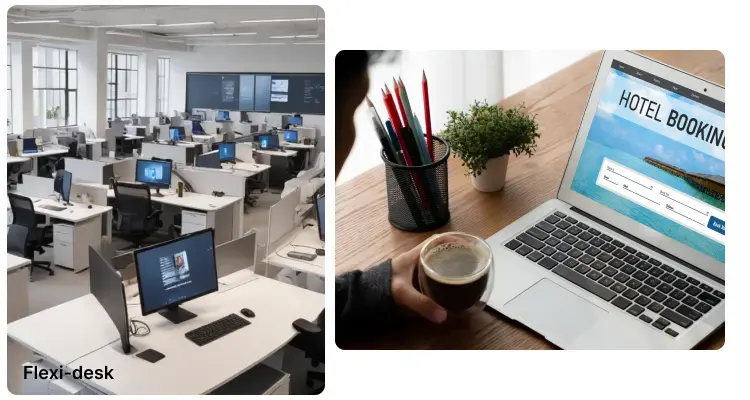
Flexi-desking provides on-demand access to seats. It requires the user to be present on-site to book, utilize, and release the seat post-usage. Desk hoteling is a slightly more sophisticated system that lets users book a seat for a specified duration, much like a hotel room.
Although these are used interchangeably, both can co-exist in a hybrid workspace model. Hence, it pays to remember that flexi-desking is on-demand and hoteling is in-advance booking.
1. Cost optimization is the primary advantage of Flexi-desking. It allows businesses to have fewer desks, which allows them to cut costs for the unused ones.
2. It also helps employers adhere to social distancing guidelines by spreading the desks and limiting the number of people on-premise. The occupancy-related data provides insights for better space utilization, scaling, and responding to shifting demand.
To fully realize the benefits of flexi-desk, you need proper planning and execution. Let’s divide the whole process into three parts:
1. Planning
2. Implementation
3. Operationalization

In the planning stage, it is imperative to chart out current and future needs. A proper framework incorporates business objectives, user needs, existing tools (and required integrations) and defines work scenarios needing different workspaces including shared areas. . You also need to define the key performance indicators (KPIs) to measure success. The KPIs would include space utilization, operating costs, desk usage, and so on.
The planning stage also includes zeroing in on the right technology to serve your specific business needs. Forward planning would require you to collect data and track the usage of your facilities. So, the technology must facilitate the collection of data and should be capable of providing actionable insights.
Implementation of a flexi-desk workplace involves two parts – technology and people. The technology part would include ensuring that your flexi-desk booking system has necessary features like scheduling, team planning, and centralized notification. If you already have these tools in place, the new solution should seamlessly integrate with them.
The people part would include creating and communicating policies around the flexi-desking system. Without know-how and buy-in from the users, even the best solution is likely to fail. Therefore, you need to communicate clearly and encourage people to try out the features before a company-wide rollout.
Operationalization of a flexi-desk office is more about driving a cultural and behavioral shift. And the larger the workforce, the longer the transition period.
You will have to develop support systems specifically for the transition period. It could be as simple as cabinets for storing belongings people tend to leave on their desks – as they do on pre-assigned or fixed desks.
You must also be prepared to handle several other scenarios related to technology and people. For instance, you need to have an alternative ready for situations like tech failure, ambiguity in SOP, and so on.
During operationalization, pay close attention to the KPIs of the shared workspace model. You must ensure that the system built matches the plan and delivers on the key metrics. At all times, be transparent and communicate the progress to the relevant stakeholders.
Even as you track your KPIs, look for the impact on a business level. The first test is the cost-effectiveness of the solution. Without a healthy ROI, it is hard to justify investment in the solution. After the teething period, check if it has improved the overall efficiency of the workplace. Assessing its impact on productivity at the business, function, location, and individual level could uncover valuable insights for improvement.
WorkInSync’s flexi-desking solutions offer not just insights but a complete package with all related tools. It saves crucial time in implementation and operationalization. Most importantly, our solutions are cost-effective and deliver a good ROI.
Subscribe to our blogs to know more about flexi-desking.
 Workplace Management
24 September 2026
Compare six workplace management platforms. See what each is suited for and how to choose the right fit in 2026.
Deesha
|
4 Min Read
Read More
 Announcement
13 August 2026
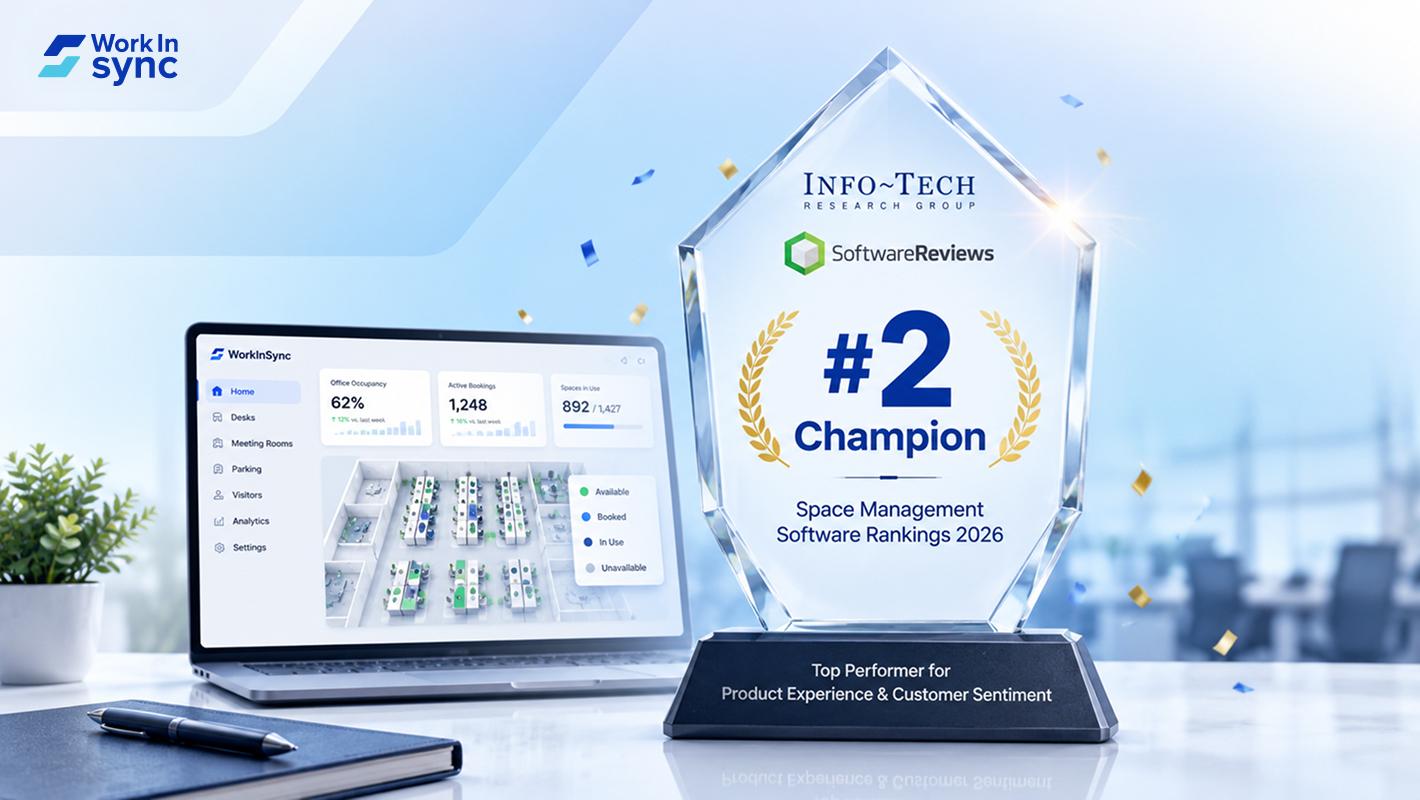
WorkInSync has been recognized by Info-Tech Research Group as a Champion in the 2026 Data Quadrant for Space Management, ranking #2, and as a Champion in the Emotional Footprint, ranking #2. Both awards are published on SoftwareReviews, Info-Tech's ratings platform, where rankings are built entirely from user feedback.

Sai Riddi
|
2 Min Read
Read More
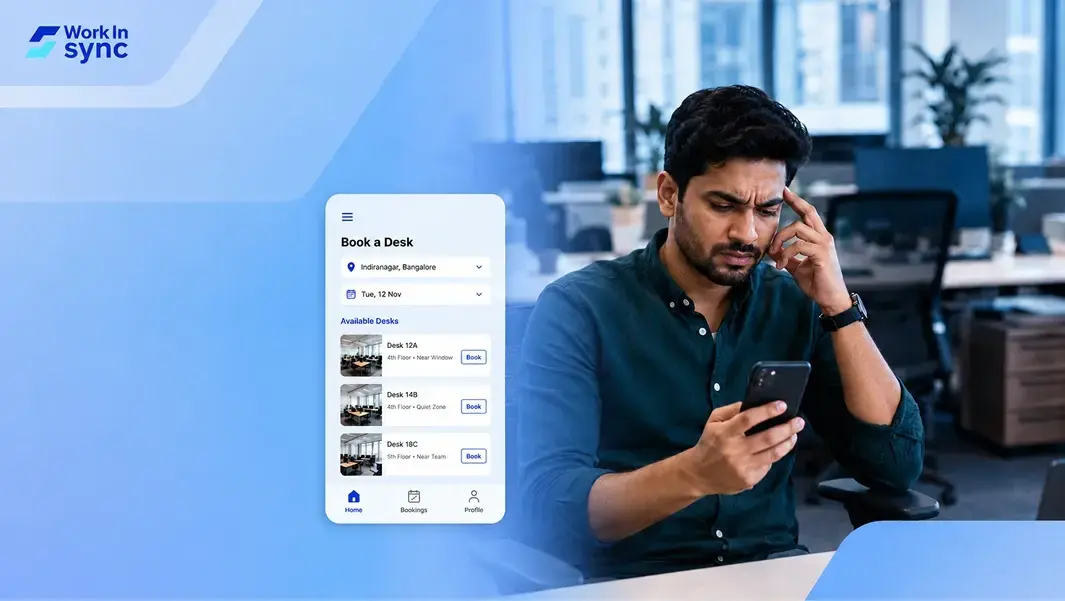 Desk Booking Software
5 June 2026
Let’s not pretend otherwise. Somewhere in your organization, a well-meaning IT or facilities team rolled out a desk booking system. There was a demo. Someone said “seamless.” There may have been a slide with the word “frictionless” on it. Leadership nodded. Procurement signed off. And then employees quietly went back to texting each other on […]

Ujjwal Trivedi
|
6 Min Read
Read More