
 Workplace Management
24 September 2026
Best Workplace Management Software in 2026: 6 Tools Compared
Compare six workplace management platforms. See what each is suited for and how to choose the right fit in 2026.

Deesha
|
4 Min Read
Read More

Key Takeaways
Every desk should feel like a good desk. Use smart lighting and design tweaks to spread the appeal.
Don’t ignore micro-battles. If employees compete for a spot, there’s a design imbalance.
Offer variety. Some want sunlight, some want silence, others want beanbags. Diversity in space = fewer fights for one desk.
Watch behaviour, not surveys. Employees might say they’re fine, but their daily seat choices tell the truth.
Every office has a legend. Not a person but a desk. You know the one. The desk by the window.
Morning sunlight streaming in, a decent view (okay, maybe it’s the parking lot, but still). It’s the first to be claimed every single day.
I once watched two employees, let’s call them Priya and Arjun, enter the office at the same time. Both clocked eyes on the window desk. Both quickened their pace. Arjun had a head start. Priya dropped her bag on a random seat, muttered “Fine, keep it”, and went off in search of coffee. The desk had spoken.
If you’re a facility manager, moments like this are gold. They’re not just quirks of workplace behavior; they’re behavioral data. They reveal how the environment nudges choices, sparks mini-competitions, and silently broadcasts what employees value most.
Why is this one seat so magnetic? Three reasons:
Humans weren’t built for fluorescent tubes. Natural light is literally brain fuel; it regulates circadian rhythms, boosts focus, and even reduces sick days.
A 2025 report highlights wellness-centered architectural design, like increased use of daylight and biophilic elements, can reduced sick days by up to 30% at workplaces. It emphasizes how natural light supports physical and emotional well-being.
That window isn’t just glass; it’s a productivity booster.
When work feels overwhelming, a quick glance at clouds rolling by or trees swaying outside gives employees a microdose of freedom. Psychologists call this “attention restoration.” Our brains reset when we connect with nature, even briefly.
Research on biophilic design shows that access to natural views can reduce stress by up to 12% and significantly improve job satisfaction.
So when employees gravitate to the window desk, they’re not just chasing sunlight; they’re chasing calm.
Corner offices may be gone, but the instinct to claim prime real estate hasn’t disappeared. That window seat signals subtle seniority: “I got here first.”
Studies on territorial behavior in the workplace show that employees are more likely to personalize and repeatedly claim the same spots when those spots are linked to visibility, comfort, or prestige.
In other words, the window desk is the modern equivalent of the corner office, with less mahogany, but the same bragging rights.
Here’s the real insight: the window seat is not just about the window seat.
If people are racing for one area, it means other zones aren’t cutting it.
If the “middle seats” are ghost towns, maybe lighting, layout, or acoustics are to blame.
If employees hover near collaboration spaces but never use them, something about the design isn’t working.
Your office is like a silent focus group. The trick is learning to listen.
At another office, a mysterious chair swap occurred. The ergonomic chair at the window kept “walking” away. Employees would arrive, only to find a basic chair left in its place. Eventually, one FM placed a cheeky Post-it on the chair: “This chair is tracked by satellite. Steal at your own risk.”
Guess what? The chair stayed put.
The moral: employees crave comfort and control, and sometimes the smallest objects (a chair, a window, even a desk plant) reveal the biggest truths about office psychology.
When you see employees racing for desks, swapping chairs, or circling like hawks for the “good spot,” don’t dismiss it as office quirks. These are signals. They show how the environment shapes experience and how psychology quietly dictates space usage.
For facility managers, the real win isn’t in making one desk the prize. It’s in designing a workplace where every desk, every nook, every corner feels like a winner. Because the best-designed office isn’t one where people fight for the window, it’s the one where no matter where you sit, you feel like you got the best seat in the house.
Workplace Management24 September 2026
Compare six workplace management platforms. See what each is suited for and how to choose the right fit in 2026.
Deesha
|
4 Min Read
Read More
 Announcement
13 August 2026
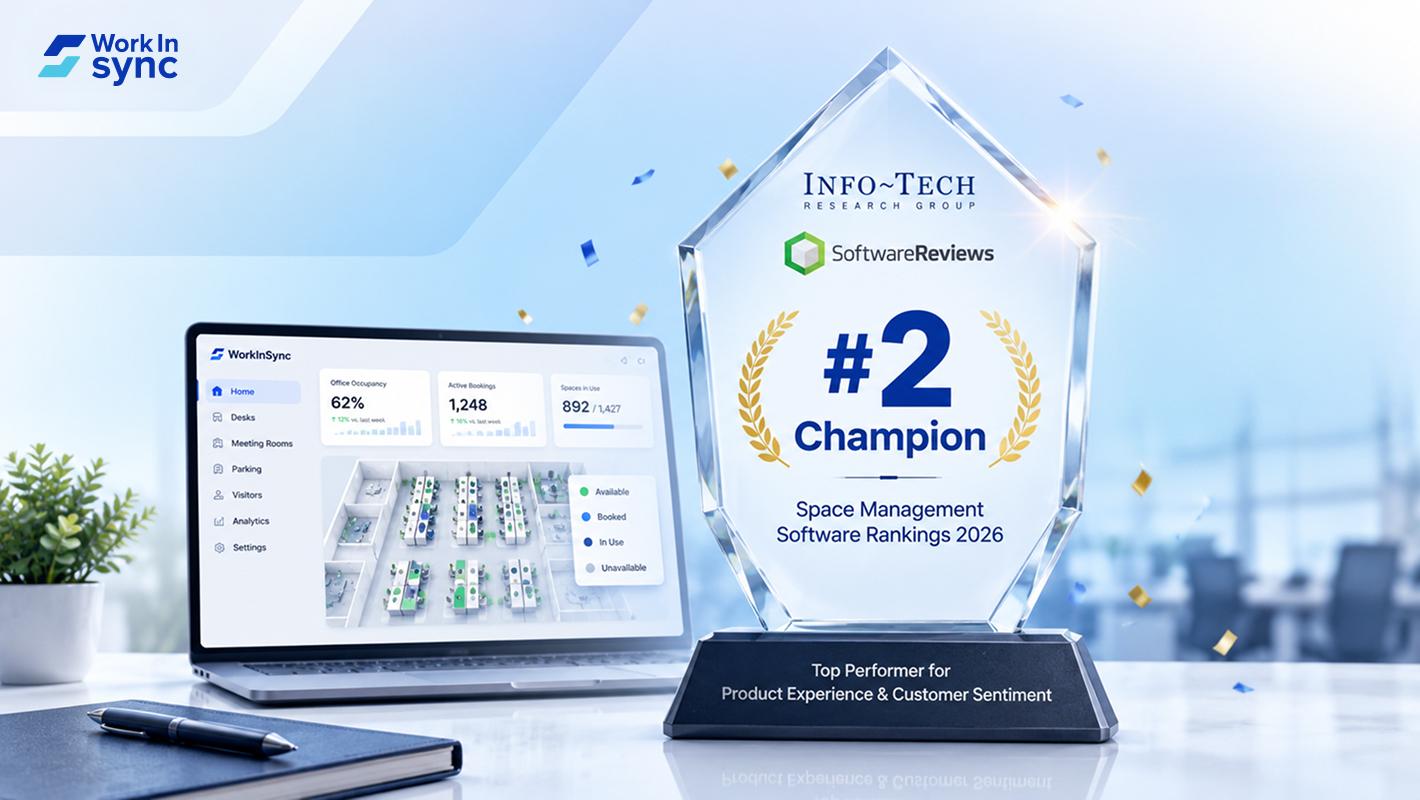
WorkInSync has been recognized by Info-Tech Research Group as a Champion in the 2026 Data Quadrant for Space Management, ranking #2, and as a Champion in the Emotional Footprint, ranking #2. Both awards are published on SoftwareReviews, Info-Tech's ratings platform, where rankings are built entirely from user feedback.

Sai Riddi
|
2 Min Read
Read More
 Desk Booking Software
5 June 2026
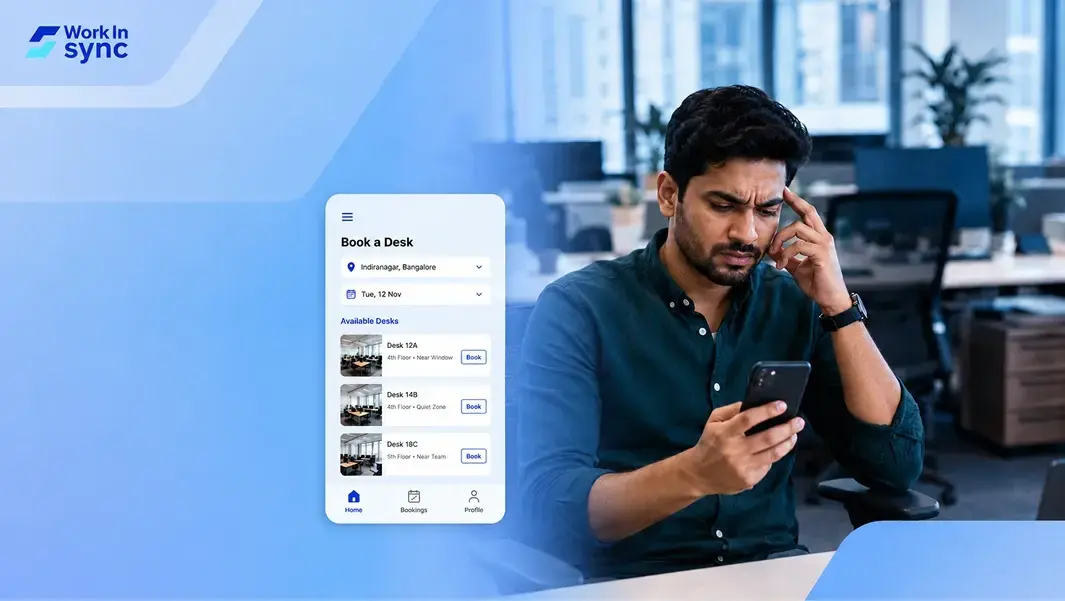
Let’s not pretend otherwise. Somewhere in your organization, a well-meaning IT or facilities team rolled out a desk booking system. There was a demo. Someone said “seamless.” There may have been a slide with the word “frictionless” on it. Leadership nodded. Procurement signed off. And then employees quietly went back to texting each other on […]

Ujjwal Trivedi
|
6 Min Read
Read More