
 Workplace Management
24 September 2026
Best Workplace Management Software in 2026: 6 Tools Compared
Compare six workplace management platforms. See what each is suited for and how to choose the right fit in 2026.

Deesha
|
4 Min Read
Read More

Key Takeaways
The pandemic reshaped workplace models, with remote, hybrid, and onsite arrangements gaining new meaning post-crisis.
Surveys show most employees prefer flexible models; US and UK data highlight demand for blended remote–onsite approaches.
Onsite work offers structured schedules, easy collaboration, unified culture, and immediate access to office resources.
Remote work enables location flexibility, no commute, and higher autonomy, but requires strong communication frameworks.
Hybrid workplaces combine in-office and remote setups, tailoring schedules, teams, and onsite requirements per organization.
Hybrid approaches vary: remote-first prioritizes home offices, occasional office balances collaboration days, office-first emphasizes onsite presence.
Comparative factors include collaboration methods, commuting needs, hiring reach, real estate costs, and virus-related resilience.
Employers increasingly adopt hybrid models as a balanced approach, cutting costs and building flexible, resilient workplaces.
The pandemic changed our workplaces forever. A new model like a hybrid workplace is gaining popularity. Existing models like on-site and remote work have gotten new meaning altogether. All of this owing to the implementation of return to office strategies.
This blog highlights each of these models and the obvious differences that exist.
Ever since the pandemic upended how workplaces operate, employees settled into working remotely. Now, as organizations reimagine workspaces, employees are unwilling to stuff the genie back into the bottle right away.
A 2020 survey reveals that 55% of workers in the US want a blend of home and office working. Similarly, UK companies expect the employees working remotely to double from 18% to 37% after the onset of the pandemic. Employment expert Alicia Tung predicts that organizations will witness a 60/40 split of onsite/work from home in the next decade.

Despite high-flying projections about permanently moving workers to remote working arrangements, employers are trying to find the middle ground. Deloitte’s return to workplace survey indicates that only 2% of company executives acknowledged taking their operations remote.
Also Read: A Practical Guide to Return to Office
Today, the phrase “return to offices” doesn’t encapsulate how onsite operations will look in the coming future. Enter a hybrid workplace, a flexible work setup that combines the work-from-home and office work arrangement. In the post-pandemic work scenario, nine out of ten organizations envision a hybrid work model going forward. They plan to club on-premises work and remote working, reports a McKinsey survey of executives across industries worldwide.
Let us understand the new normal of work by comparing the different models of work.
Working from a physical office, full-time, is what most employees worldwide were used to before the pandemic struck. Here, workers must adhere to regular working hours defined by employers and pursue a daily commute to the office. Here are some benefits of working onsite:
Ease of communication and interaction with coworkers
Fewer distractions from pets, family members, etc.
A unified company culture leads to heightened employee productivity, and a sense of purpose
Quick access to the company’s equipment and facilities
Unlike a remote or a hybrid workplace, most employees are familiar with this work environment
In remote working setups, employees, including team leads, managers, and founders, work away from a physical office space. They function from home offices, co-working spaces, coffee shops, etc. When companies go fully remote, they can do away with having a physical office. Remote setups ensure the following and more:
The freedom to work anywhere, anytime
No commute
Fewer distractions from coworkers
In this model, employees function remotely, on the go, or from the office premises. The combination of employees in a hybrid workplace can vary for different organizations. The structure typically comprises a skeletal staff that switches between remote and office work.
The hybrid workplace may include employees mandated to be on the premises. They can have a different assortment of teams on varying days and shifts as well. Or some organizations may reserve specific days to be onsite for meetings, get-togethers, etc.

Before adopting a hybrid workplace model, organizations must define the approach that best complements their workforce’s needs. Let’s look at the different variations of a hybrid workplace.
Bonus Read: 4 Advantages of a Hybrid Workplace
#1 Remote-First Hybrid Workplace
In a remote-first approach, the hybrid work model will closely mirror the operations of its fully remote counterparts. Here, the primary option for employees will be to work from home. The exact arrangement can depend on business requirements and personnel availability.
#2 Occasional Office Hybrid Workplace
The occasional office hybrid workplace refers to a model which blends remote work with in-person collaboration. Here, employees will be required to go onsite a few days a week on designated office days.
#3 Office-First Hybrid Workplace
In the office-first hybrid workplace model, the office serves as the primary workspace. However, employees get the choice of working remotely. Companies can designate specific teams to work from the office to avoid confusion, while the rest can stay remote.
Recommended Reading: How to Make Hybrid Workplace for All
| Onsite Work | Remote Work | Hybrid Workplace |
Collaboration | Employees working onsite can enjoy critical advantages since they can collaborate with their team members directly. | Since all employees operate remotely, the organization need a uniform collaboration and proper communication system. |
Employees can utilize time in the office for meetings, and team-building exercises. In contrast, remote days enable employees to perform solo work.
|
Commuting | In a full-time onsite work model, workers will routinely spend time and money traveling to offices. | Remotely working reduces the time and cost of daily commutes. |
In a hybrid workplace, workers will only be required to commute during onsite working days.
|
Hiring |
Organizations with an onsite work model may face a challenge in recruiting talents from across the world. |
In 2021 and beyond, companies can recruit potential employees with skills instead of their locations. |
By offering a hybrid workplace, they can hire employees from all across the globe. |
Real estate costs | In the on-site model, greater employee density in offices was the primary real estate strategy to reduce overhead costs.
|
Organizations transitioning to a remote model can cut back on various realty costs, including parking and transportation privileges.
|
Adopting a hybrid workplace makes room for a sizeable amount of savings in office expenses. This can include rent, furniture, stationery, etc.
|
Threat of viruses | On-site setup will require IT managers to equip their offices’ with contactless temperature detection tools and thermal scanners. They can refuse admission to employees not fulfilling the health prerequisites. | A remote setup will help keep the Covid-19 related concerns at bay as employees will not interact face to face. | Organizations are adopting a hybrid workplace model to build and nurture a resilient culture in case of future lockdowns.
|
Bonus Read: Understanding New Work Models
The return from remote work is ripe with innovation potential as employers reimagine how and where work gets done. However, adopting hybrid workplaces will not fix the umpteen workplace challenges. A hybrid workspace supersedes multiple shortcomings of remote and onsite work arrangements. This is why organizations can make the most by empowering their employees with the right tools.
WorkInSync understands the needs of the future of work and offers an exclusive suite of hybrid workplace management tools. Leverage easy solutions and streamline hybrid work processes with ease!
Subscribe to our blog to know more about the latest developments in the hybrid workplace.
 Workplace Management
24 September 2026
Compare six workplace management platforms. See what each is suited for and how to choose the right fit in 2026.
Deesha
|
4 Min Read
Read More
 Announcement
13 August 2026
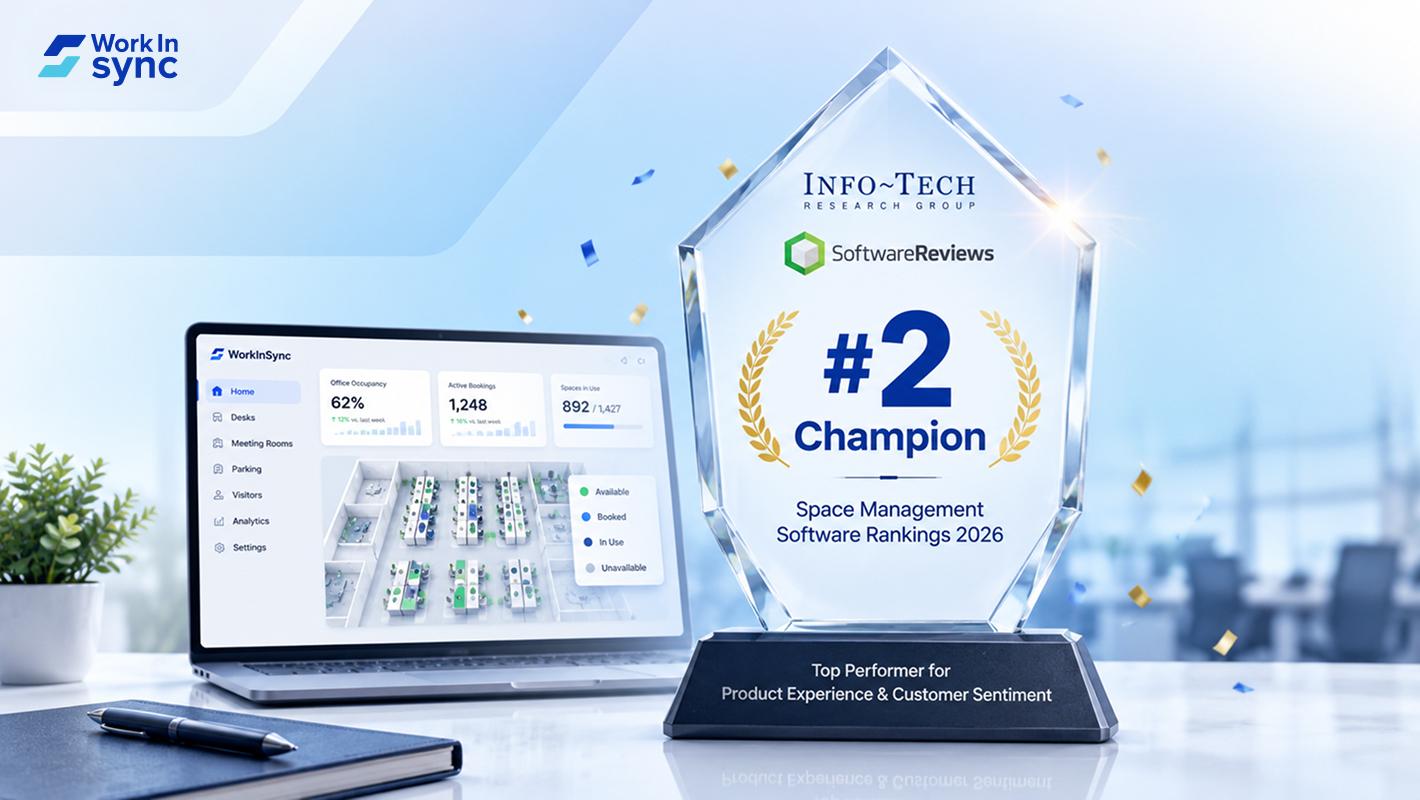
WorkInSync has been recognized by Info-Tech Research Group as a Champion in the 2026 Data Quadrant for Space Management, ranking #2, and as a Champion in the Emotional Footprint, ranking #2. Both awards are published on SoftwareReviews, Info-Tech's ratings platform, where rankings are built entirely from user feedback.

Sai Riddi
|
2 Min Read
Read More
 Desk Booking Software
5 June 2026
Let’s not pretend otherwise. Somewhere in your organization, a well-meaning IT or facilities team rolled out a desk booking system. There was a demo. Someone said “seamless.” There may have been a slide with the word “frictionless” on it. Leadership nodded. Procurement signed off. And then employees quietly went back to texting each other on […]

Ujjwal Trivedi
|
6 Min Read
Read More