
 Workplace Management
24 September 2026
Best Workplace Management Software in 2026: 6 Tools Compared
Compare six workplace management platforms. See what each is suited for and how to choose the right fit in 2026.

Deesha
|
4 Min Read
Read More
Key Takeaways
Hybrid workplaces offer a flexible mix of on-site and remote work, ideal for the post-pandemic era where both productivity and employee preferences matter.
Surveys show overwhelming support: 83% of workers prefer hybrid models, and major companies like Microsoft, Reddit, and Twitter are leading the shift.
For employees: Hybrid work boosts productivity, enhances work-life balance, and nurtures happiness by allowing personalized routines.
For employers: It reduces operational costs, promotes safer workplaces through controlled occupancy, and improves employee satisfaction and retention.
With flexible scheduling, lower overheads, and higher engagement, the hybrid model isn’t just a trend, it’s the new standard.
WorkInSync helps simplify hybrid transitions with tools that manage scheduling, space, and collaboration. Subscribe for more hybrid workplace insights.
The hybrid workplace is under the spotlight for all the right reasons. This blog explores the advantages of a hybrid work model, which proves it is here to stay for a long time.
Companies worldwide are updating their way of work. During the pandemic, everyone shited to working from home. It was convenient for the employees, and productivity skyrocketed.
But as companies implement a return to the office, the future of work has found a new face in the hybrid workplace.

It is essentially a mix of on-site and remote work. Some employees work from the office a few days a week and remote the remaining days. In a few organizations, some teams might work on-site all day, and others will work remotely. But to achieve a hybrid workplace, the split has to be 80-20.
Also Read: What is a Hybrid Workplace?
The idea of the hybrid work model is to provide the best of both worlds. In the process, it eliminates the challenges that come with both on-site and remote work.
The hybrid workplace seems like the best way out. Executives from across the world have recognized the need to make workplaces flexible. And hybrid is synonymous with it.
Let us look at a few numbers to understand this better.
Although we have highlighted a few reasons for the long-term traction of a hybrid workplace later in the blog, there is one primary reason. There seems to be a gap between employer expectations and employee preferences. And a hybrid workplace fills in the gap.
Here are a few stats that analyze the rise of a hybrid workplace in 2021 and beyond.
According to Pew Research, one in five employees in the US have been remote workers before the pandemic
During the pandemic, the number jumped to seven out of ten
54% of the respondents in the same survey would like to continue remote after the pandemic ends
In an Accenture survey, 83% of 9000 respondents want a hybrid work arrangement
62% of executives in a PwC survey said that 2 to 4 days in the office is necessary to maintain company culture
In the same survey, 21% of executives wanted a 5-day full-time work week
Deloitte’s Return to Office survey had 32% opt for a hybrid workplace to maintain company culture
A Harris Poll/Sungard AS research shows 43% of people wanting permanent remote work compared to 51% who want a hybrid model
In an Accenture’s report, 74% of GenZ workers want to work from the office
In the same report, 68% of baby boomers and 66% of millennials want to work from the office
*Source: Apollo Technical
The proposed hybrid workplace is the best model as we advance. At least, that is what the numbers suggest. As we mentioned, a hybrid workplace fills in the gap that both on-site and remote work leave.
Flexibility is one of the biggest draws of a hybrid workplace. This is followed by less commute time, more face-to-face interaction with colleagues, and increased productivity.
In October 2020, Reddit announced the adoption of a hybrid workplace. The employees could either work remotely or from on-site.
Not only Reddit but many other high-level organizations have adopted a hybrid working model.
Twitter was the first organization to announce a hybrid model for its employees. Coinbase, a cryptocurrency trading firm, introduced a “remote-first” workplace model to remain fully operational even during the pandemic.
The hybrid model was initially adopted as an experiment. However, the arrangement is now shifting towards a more permanent system.
Microsoft has allowed its workforce to be remote for half of the week. Other popular companies that have gone flexible include Salesforce, Dropbox, Shopify, Facebook, Zillow, and Viacom. The trend is catching up. More names keep adding to the list.
As businesses return to the office, hybrid workplaces have become a testimony to the flexible setting. And the new generation is wildly attracted to such a setting.
The hybrid workplace model cuts down the operational cost for businesses. It provides flexibility to the employees. Hybrid workplaces do not refer to changing the location of work or the way you work. It is about providing flexibility to work from anywhere.
Recommended Reading: 5 Hybrid Workplace Trends
Here are several reasons for the hybrid workplace to stay.
Before the pandemic, there existed several myths about the hybrid workplace. Managers usually think that productivity will be affected if the employees are given the freedom to choose their working hours.
But, the pandemic showed an alternate reality.
A study by Microsoft shows the employee performance during the pandemic increased. About 82% of leaders say that their employees have become more productive.
With no commute required, employees can focus on their work. By choosing their work hours, they can work when they are most productive. So if someone is highly productive during the night, they can adjust the routine accordingly.
That is what a hybrid workplace allows.

Freedom to work from a preferred location impacts employee happiness.
Although, a Survey Monkey Report proved that remote employees are happier than people who work from the office. Hence, the keen dependence on the hybrid workplace.
Remote work has its advantages. Nevertheless, it can cause isolation.
The hybrid system can mitigate this difference. With the balance, employees can retain flexibility; while being happy.
In the hybrid office setup, companies can manage their real estate. In a study by PWC, 31% of executives anticipate the need for less office space due to increasing remote workers.
Managers are getting creative with the office space. There is an increase in collaborative hubs like small conference rooms. Private offices have been introduced. Social distancing protocols have given way to concepts like hot desking and hoteling.
Reduced real estate is directly proportional to reduced operational costs. Companies can enjoy a massive cut down in their rental costs. The need to provide more amenities also decreases significantly.
All of this has inspired organizations to retain the hybrid work model.

Although the pandemic is slowing down, health experts are yet to lift COVID protocols. Employees can be vaccinated, but organizations are keen on retaining safety compliance.
Social distancing is a significant factor in curbing the virus. This means that employees need to be seated at a safe distance from each other. Occupancy limits need to be set. Overcrowding has to be avoided.
If the number of employees visiting the office is constricted, you can subside the fear of the virus. To be precise, managers can call different employees on different days. Our schedules can be spread across the day to avoid overcrowding.
A hybrid workplace accommodates this. Hence, it’s a long-lasting run.
One of the most sought-after advantages of a hybrid workplace is the balance it offers. With increased productivity and happiness, satisfaction also increases. Your aim should be to create seamless employee experiences.
Microsoft’s 2021 Work Index shows that 73% of employees want a hybrid workplace. By implementing one, a company reduces attrition. It also opens up the chance to hire talents from different geographies.
A hybrid workplace ensures to retain employees by providing flexibility. Hence, it is here to stay.
The hybrid workplace is the need of the hour. But before making decisions, you should learn about its pitfalls as well.
Data and market trends show increased adoption of the hybrid workplace. Therefore, it is safe to say; the hybrid workplace is here to stay!
WorkInSync is a leader in the hybrid management industry. With a robust app, it takes care of each implementation step. Subscribe to our blogs and stay updated with the latest hybrid work trends.
 Workplace Management
24 September 2026
Compare six workplace management platforms. See what each is suited for and how to choose the right fit in 2026.
Deesha
|
4 Min Read
Read More
 Announcement
13 August 2026
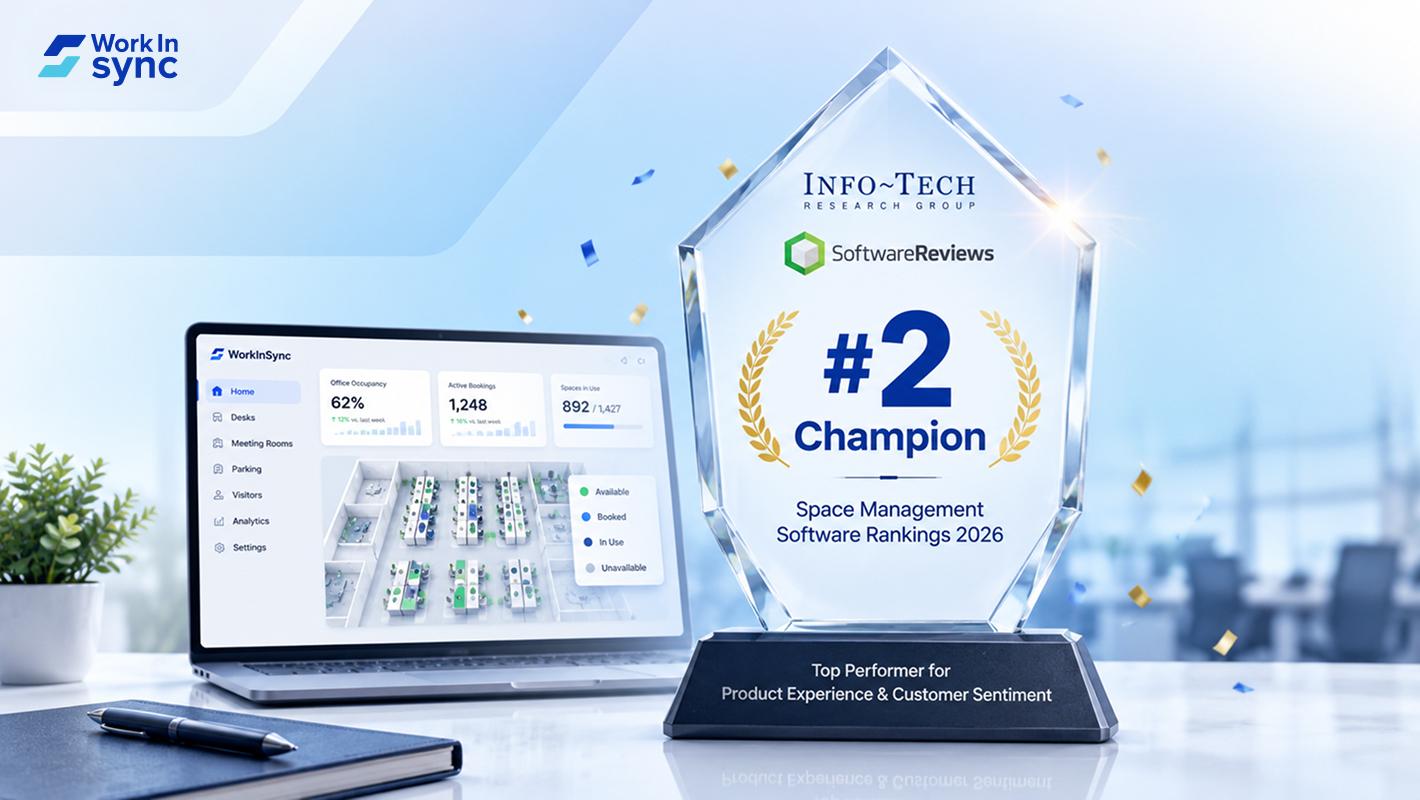
WorkInSync has been recognized by Info-Tech Research Group as a Champion in the 2026 Data Quadrant for Space Management, ranking #2, and as a Champion in the Emotional Footprint, ranking #2. Both awards are published on SoftwareReviews, Info-Tech's ratings platform, where rankings are built entirely from user feedback.

Sai Riddi
|
2 Min Read
Read More
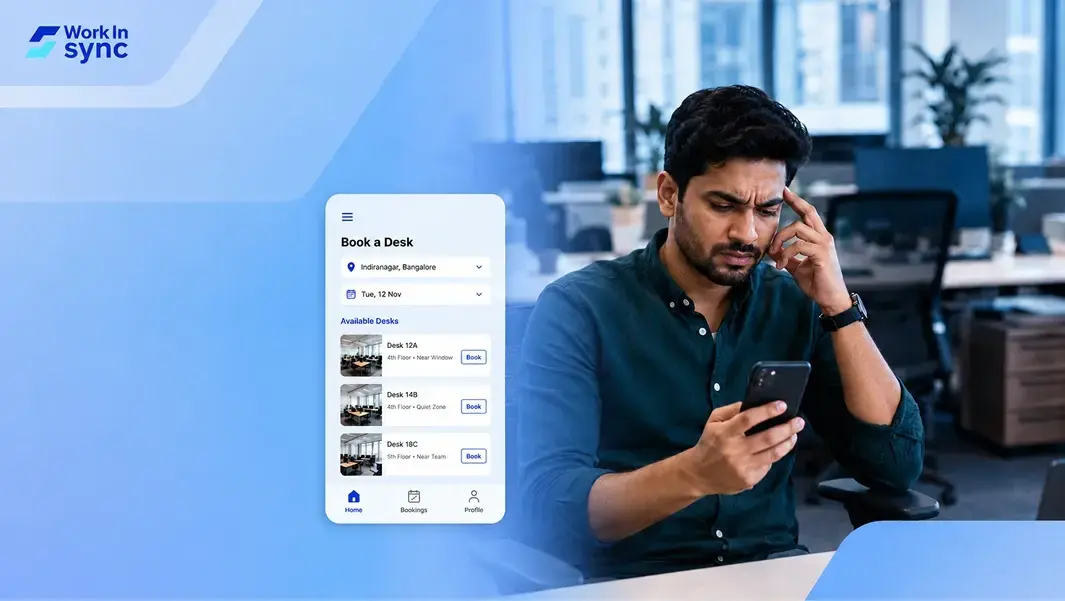 Desk Booking Software
5 June 2026
Let’s not pretend otherwise. Somewhere in your organization, a well-meaning IT or facilities team rolled out a desk booking system. There was a demo. Someone said “seamless.” There may have been a slide with the word “frictionless” on it. Leadership nodded. Procurement signed off. And then employees quietly went back to texting each other on […]

Ujjwal Trivedi
|
6 Min Read
Read More