
 Workplace Management
24 September 2026
Best Workplace Management Software in 2026: 6 Tools Compared
Compare six workplace management platforms. See what each is suited for and how to choose the right fit in 2026.

Deesha
|
4 Min Read
Read More

Key Takeaways
Office occupancy rarely exceeds 60% even on peak days, underscoring the need to downscale fixed infrastructure.
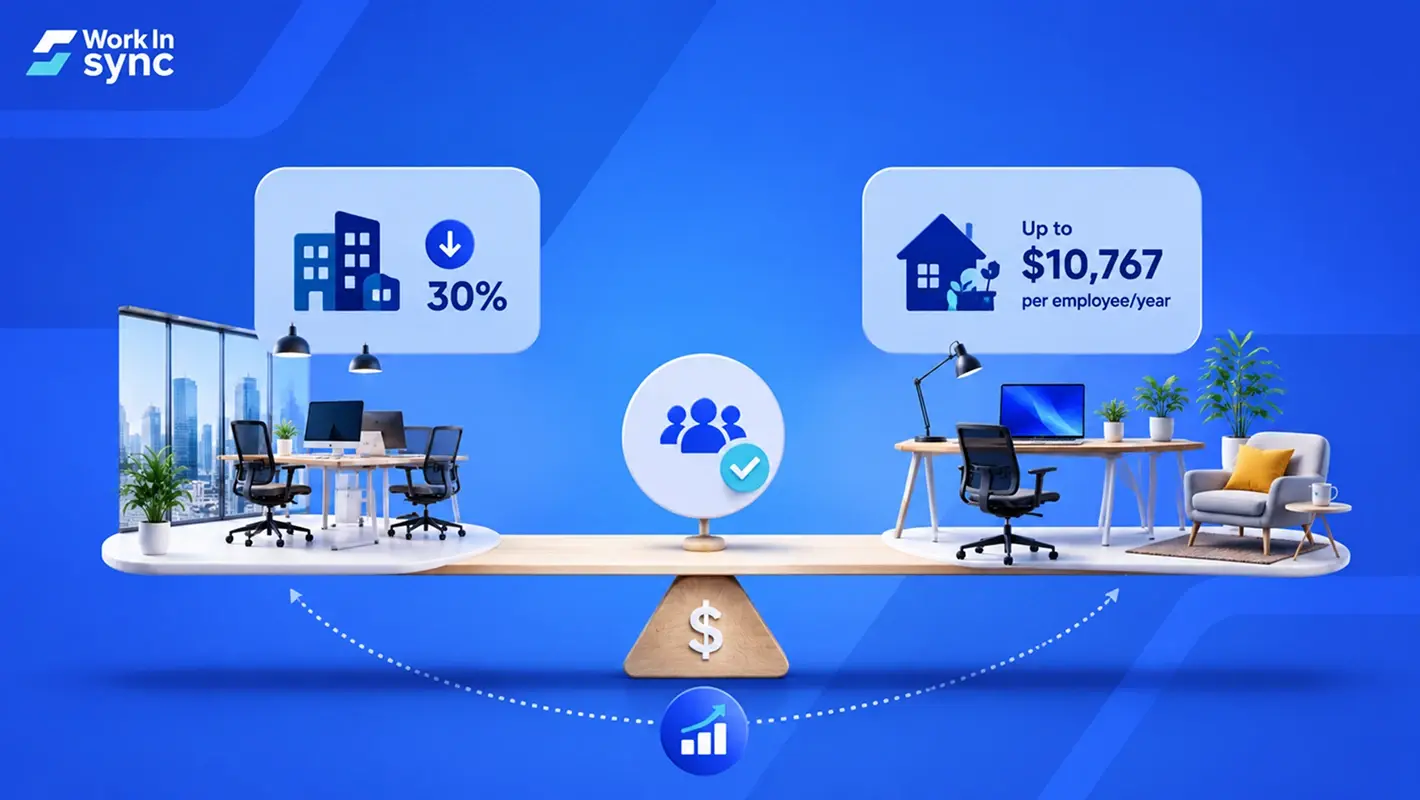
Companies adopting hybrid models report 30% real estate savings and improved employee autonomy and satisfaction.
Companies save up to $10,767 per employee annually, but need to budget wisely for both office and home setups.
Common mistakes like maintaining unused office space and choosing the wrong hybrid model makes hybrid setups expensive and inefficient.
To optimize hybrid costs, businesses should align the model with employee preferences, reallocate budgets efficiently between office and home setups, and use space flexibly through activity-based zones and modular pods.
Office setups focus on shared infrastructure like desks, meeting rooms, WiFi, AC, and sanitization while home setups prioritize individual comfort through ergonomic furniture, connectivity, and accessories to maximize productivity in employees.
Tools like WorkInSync can simplify hybrid management with desk booking, room scheduling, and occupancy analytics at an affordable price.
A hybrid workplace is no longer a buzzword. It has become the future of work. But how much does it cost to set up a hybrid workplace? This blog explores the same and helps you understand the factors that makes it expensive.
Hybrid workplaces are the future; there is no doubt about it. The hostile approach to flexible working changed during the pandemic. Now, we have industry giants like Apple, Amazon, and Microsoft adopting the hybrid work model.
This adoption has helped organizations empower their employees with more autonomy over their work schedules. Also, the sharp increase in productivity during the last two years convinced the higher-ups that hybrid does work.
While the employees benefit from hybrid workplaces immensely, organizations too gain from it. To illustrate it further, a report from Global Workforce Analytics highlighted that a typical employer in the US could save up to $10,767 per employee in a hybrid arrangement. This largely hinges on the fact that a hybrid workplace requires 30% less real estate.
However, this real-estate element is not as simple as it looks. Some big companies will save close to the figures mentioned above. But for those organizations that have gone entirely remote, the cost savings from real estate will be absolute.
Therefore, companies who adopt the hybrid work arrangement will save some of their real-estate cost. It is also important to note that cost savings are not limited to real estate. Overhead costs like providing amenities to the employees have also been reduced. As most employees work from home, you do not have to keep up with the pre-pandemic desk count.
And what happens when you free up desks? It leads to additional cost savings.
Also Read: How to Optimize Real Estate Cost?
With increased cost savings and decreased real estate requirements, organizations are faced with a far more difficult question – how much does it cost to set up a hybrid workplace?
Businesses across the globe are repurposing their office space to accommodate the flexible work approach. The mission is simple for all. They want the hybrid work model to succeed. But to witness success, it is essential to understand the financial implications of the same.
This article breaks down the costs associated with a hybrid workplace. We have considered two types of office space an organization needs to establish a hybrid model. We will also consider the factors that make the hybrid model expensive. All of this ensures that you are never left in the dark.
Learn how leading companies keep expenses in check while optimizing space and employee experience.
Before the pandemic, real estate was a fixed cost for companies. So, the per employee cost was pretty straightforward.
A note of caution here, though. The per employee cost varies from one company to another. Factors like location, size of the employer, and the type of office had a significant impact.
Nevertheless, we have taken an average for a mid-sized company with an open office concept based out of London and New York. We are also looking at a typical 5-day office system here.
The average cost per employee in London was £500 per month
The average cost per employee in New York was $510 per month
This cost included desks, parking space, free coffee, free meal, and even gym facilities.
But with the 5-day workweek becoming a thing of the past, office costs have reduced significantly. Many organizations, for instance, Cisco, have already highlighted the transition of workplace costs from fixed to variable.
Let us understand this methodically.
Bonus Read: Understanding the Different Types of Work Models

The last two years induced an overall change in businesses. Companies today prioritize employees over everything else. The pandemic made it clear that happy employees will ensure company growth.
And if you want to win the talent war, you will need to uphold employee well-being. An effective way to do so would be to assign a budget where the employees want to work.
For instance, your employees work from the office two days a week and the rest of the days they work from home. You can re-allocate the office budget maximizing productivity and efficiency of whichever workplace they choose.
This could mean creating high-quality office space and offering curated home equipment.
To make it easier, we have broken down the equipment or facilities they may need based on today’s two most prevalent workspaces. This will help you understand where to assign the budget.
An employee’s relationship with their office has changed owing to the hybrid work model. Concepts like hoteling and hot desking have become popular.
Studies have also shown that the number of desks required can be curtailed. The maximum occupancy your office reaches on the busiest days is approximately 60%; you can let go of desks that are hardly in use.
Also, cubicles are no longer preferred. Instead, employees would like individual pods that can be used when wanting to move away from the hustle-bustle of the office.
Also Read: How to Design a Hybrid Workplace for Better Space Management?
Collaboration has become a significant reason for employees coming to the office. This resonates with the need for meeting rooms and open collaboration spaces. Creative zones that are open, flexible, and activity-based are in demand.
Good WiFi, desktops (if required), an air conditioning system, and even natural lighting will be a part of the office hybrid budget. Although often ignored, employees have already highlighted that these matter a lot.
Well-managed office space has better implications for employee experience.
Sanitization efforts are another overhead cost that you should consider for your hybrid workplace. Employees are ready to come to the office if it is clean and safe. Therefore, you will need to ensure that cleaning facilities are in place.
To sum it all up, you will need to consider the following for your hybrid workplace budget when working from the office.
Hot desks
Permanent desks
Personal pods
Meeting rooms
Open collaboration spaces
Sanitization
WiFi
Air conditioners
So, what should be the budget for an office in a hybrid workplace? Experts believe that the cost would be roughly £200/$204 per employee per month with refurbished offices.
The hybrid workplace is rewriting our present and future. Download this report to find out interesting data about the hybrid workplace.
When working from home, employees are in their natural habitats. From the air conditioner to the lighting, everything is under their control.
Companies that have adopted the remote-first approach believe that this setting has no cost. However, many employees have complained that a proper workstation at home can help them be more productive.
In a survey involving 856 people working in a mid-sized company, 28% of the respondents were working from the master bedroom (often shared with other family members).
In another survey, 42% of the respondents said that they were either sitting on the dining chairs or their beds/ couches when working.
People working from their couch or bed are 20% less productive than those sitting on ergonomic chairs.
So, where does your hybrid workplace budget fit in? Well, employers can fix this situation by providing a proper workstation to remote employees.
We will not consider laptops or desktops here. But you can help the remote workers get proper WiFi connectivity. Employers can provide access to ergonomic furniture like a desk and chair. Curated facilities like headphones can also be given to these remote workers.
Recommended Reading: Is Remote Work Making You Productive?
By assigning a budget to the home office setup, you can help employees be productive.
So, to put it together, you can provide the following and include them in the hybrid budget for people working from home.
Desktops/ Laptops
Ergonomic furniture
WiFi connectivity
Curate facilities or treats like headphones
So, what should be the budget for an employee working from home in a hybrid workplace? According to studies, the cost would be roughly £100/$102 per employee per month.
On a side note, a hybrid workplace is cheaper than a traditional office setting. For instance, a company with 100 employees in the conventional office setting would spend around $50,400* per month. The cost can come down to $14,790* per month in a hybrid workplace.
*Please note that these numbers are taken on average. The number may vary depending on the company’s size, the amount spent per employee per month, and the location.
From space planning to automation, WorkInSync helps you build a cost-effective hybrid workplace that works.

The hybrid work model skyrocketed last year due to the multitude of advantages it offers. However, as a relatively new concept, it might be challenging to tread around unchartered financial territories. When implementing the model, employers make financial mistakes that increase the budget.
Here are a few reasons that make your hybrid workplace expensive.
We ran various surveys and found out that the maximum capacity is up to 60% on the busiest days. Not all employees are there in the office at the same time anymore. This means that much of the office space remains empty.
Several desks, particularly, tend to be empty. Maintaining these desks can be an added cost for your company.
The general trend has also shown that employees now prefer open meeting spaces to closed ones. Again, maintenance costs can shoot up trying to keep up with these spaces.
What is the solution? Look out for such spaces and desks. Analyze the occupancy rate of your workplace. Filter out empty desks and meeting rooms, and convert them into places that add value to your employees.
Invest in open, flexible workspaces. If required, you can change them into individual work pods or a meeting room if demand rises.
To ensure that your hybrid workplace budget stays under control, you need to ensure that there is no wastage of office space.
Also Read: How does Space Management Help Improve Employee Experience?
There are different types of hybrid work models. The office-first hybrid model sees more employees coming to the office frequently. In comparison, the remote-first model rarely has employees coming to the office.
Your employees want to adopt the remote-first model; however, you have implemented the office-first approach. So, you spend money on office space when you don’t need to.
Before committing to a hybrid workplace model, ensure that it is what your employees want. Get their opinion on the type of hybrid workplace they prefer before implementing one.
This will ensure that you are not spending money on a project that adds no value.
This may be the easiest thing to do right now. However, companies ignoring the implementation of a hybrid workplace may have to spend more money in the long run.
Hybrid workplaces have been deemed as the future of work. So, hybrid workplaces will continue to create a buzz even when the pandemic is over.
If you do not re-allocate your workplace budget to implement a hybrid workplace, you will fall back. It may also cost you, employees.
So, allocate some budget to creating a hybrid workplace.
Bonus Read: 7 Signs You Need a Hybrid Workplace
We at WorkInSync can help you establish a hybrid workplace at a budget of your choice. Recognized as one of the world’s highest-rated hybrid workplace software, we implement and manage your hybrid workplace. You get an array of features such as desk booking and meeting room management, office neighborhoods, and occupancy rate.
All of it at an affordable price. Get in touch with us to know more about the product.
Want to read more articles like these? Subscribe to our newsletter and get the latest resources delivered to your inbox.
 Workplace Management
24 September 2026
Compare six workplace management platforms. See what each is suited for and how to choose the right fit in 2026.
Deesha
|
4 Min Read
Read More
 Announcement
13 August 2026
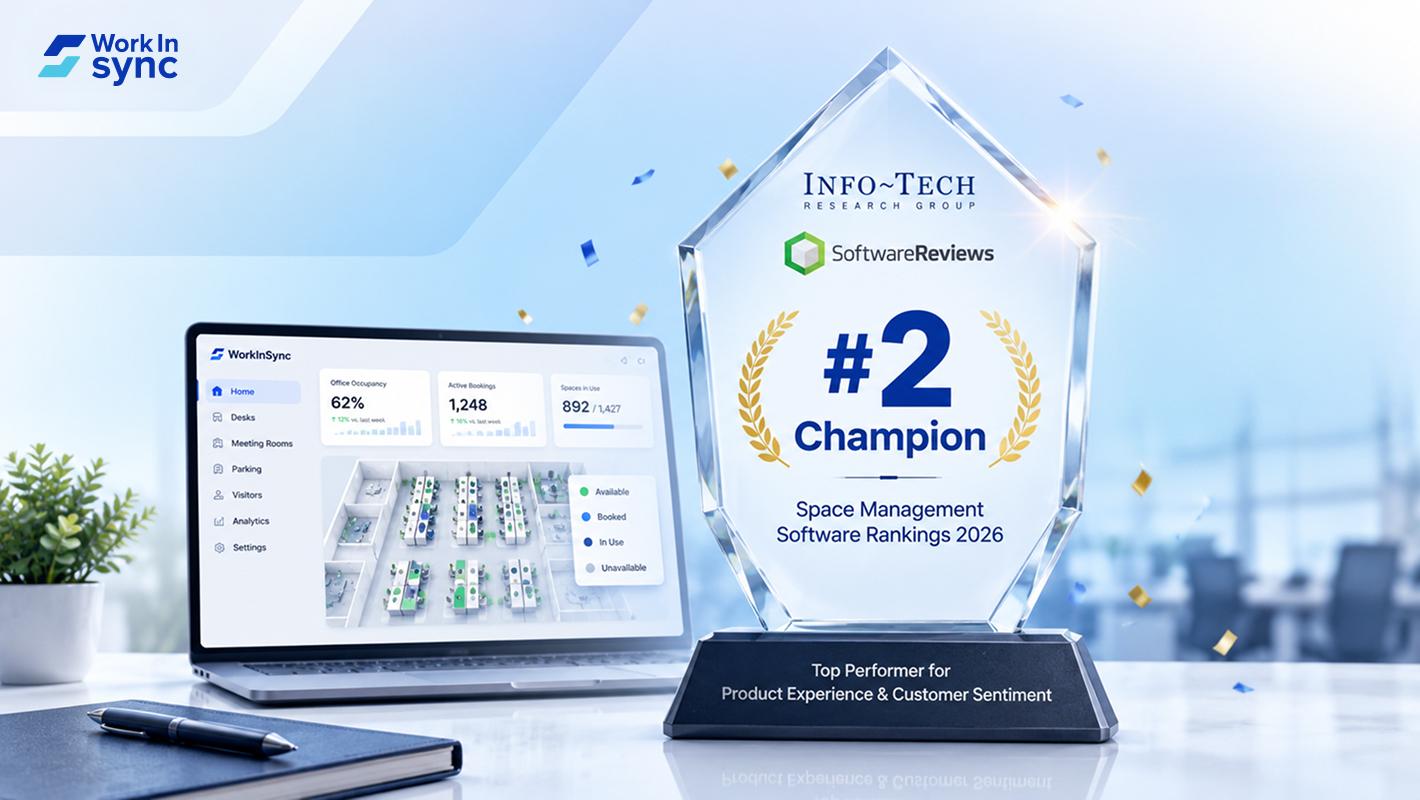
WorkInSync has been recognized by Info-Tech Research Group as a Champion in the 2026 Data Quadrant for Space Management, ranking #2, and as a Champion in the Emotional Footprint, ranking #2. Both awards are published on SoftwareReviews, Info-Tech's ratings platform, where rankings are built entirely from user feedback.

Sai Riddi
|
2 Min Read
Read More
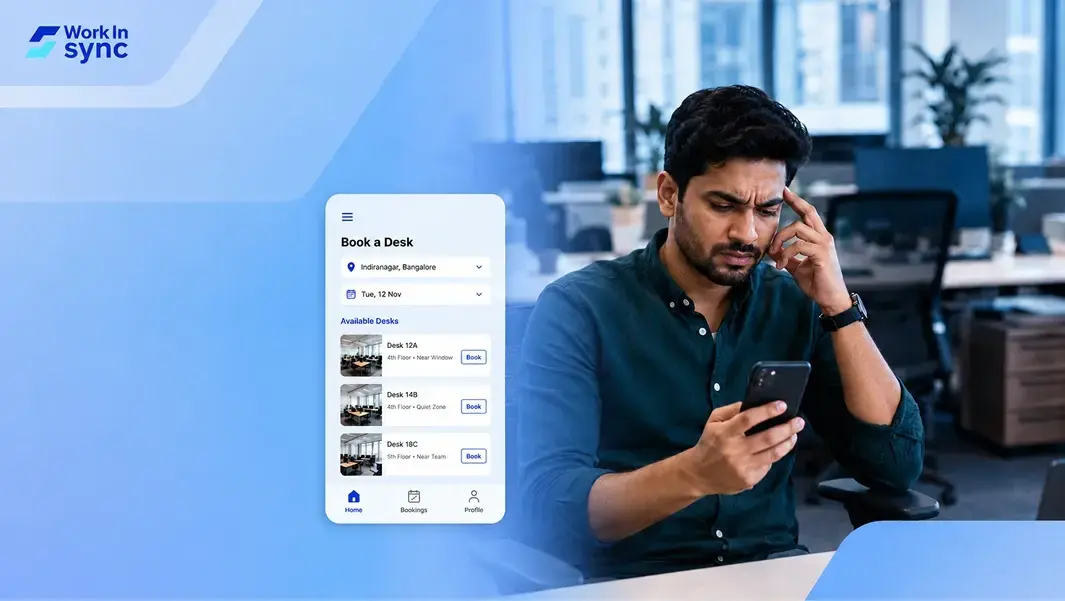 Desk Booking Software
5 June 2026
Let’s not pretend otherwise. Somewhere in your organization, a well-meaning IT or facilities team rolled out a desk booking system. There was a demo. Someone said “seamless.” There may have been a slide with the word “frictionless” on it. Leadership nodded. Procurement signed off. And then employees quietly went back to texting each other on […]

Ujjwal Trivedi
|
6 Min Read
Read More