
 Workplace Management
24 September 2026
Best Workplace Management Software in 2026: 6 Tools Compared
Compare six workplace management platforms. See what each is suited for and how to choose the right fit in 2026.

Deesha
|
4 Min Read
Read More

Key Takeaways
The shift to hybrid work began in 2020 and continues to evolve as companies explore more flexible, digital-first operating models.
A hybrid workplace blends autonomy with structure, offering flexibility while maintaining collaboration and productivity.
Experts recommend strategies like working from home 2 days a week and rethinking real estate layouts to support safety and focus work.
Key features of the modern hybrid workplace include AI-powered safety, touchless tech, smart buildings, and real-time space usage insights.
Asset and facility monitoring is becoming essential, with tools offering centralized control and environmental health tracking.
Despite past success with remote work, hybrid setups present new challenges like emotional disconnect and increased attrition risks.
Leaders must move beyond just tech upgrades, actively listening, involving teams, and co-creating future work models is critical.
Success will come from embracing a test-and-learn mindset, guiding teams through flexible principles rather than rigid solutions.
The workplace has changed permanently; adapting with empathy, evidence, and experimentation is the way forward.

Capt. (Dr.) Sukhwinder Kaur is an experienced facility management professional and is currently employed as the General Manager at OCS Group UK. A practical explorer and a rich storehouse of knowledge, she shares her opinions on a hybrid workplace in this article.
A landmark year in world history: 2020. COVID-19 drove a majority of the workforce out of offices. The hybrid workplace saw a massive rise.
The population of people working from a home office became immensely popular. 2021 is witnessing an increasing population of vaccinated people. This has started the talks of the hybrid workplace and RTO (Return to Office). Slowly, the actual “unlock” is happening.
The return to office is an opportunity to develop a new, more effective operating model that works for companies. As companies navigate a world of increasing uncertainty, they must face the widening disconnect between the actual and expected work arrangement.
There needs to be an infrastructural change. A paradigm shift is required in the new company culture.
It is imperative to take cognizance of some interesting facts before we get into a deeper discussion on the hybrid office.
A hybrid workplace model combines the structure of office collaboration with the flexibility of remote work. It is more complex than it first appears because the term covers several possible ways of working, depending on how organizations balance autonomy, in-person interaction, and business needs.
Hybrid work gives more autonomy to staff to fit their work around their lives. rather than to organize the rest of their weekdays around hours clocked in an office. Ideally, it combines structure and sociability with independence and flexibility.
Nicholas Bloom, an economics professor from Stanford University economics professor commented that working from home two days a week will be optimal for better collaboration.
There will be an added advantage of reduced stress of less commuting. He further suggests that companies that want to retain their real estate should consider moving to industrial parks to facilitate social distancing.
Anita Williams Woolley is a researcher for organizational behavior and theory at Carnegie Mellon University. She believes that organizations must evaluate their space. Although, she opines that meeting spaces should be kept intact.
She said, “I’d keep the conference room, maybe get rid of some of the cubicles that nobody likes anyway.” Wolley further added that she would invest in private workspaces for the people in the office.
RTO is indeed more complex than it appears. However, with the right solutions, we can create a digital-first model that is secure and fits our specific needs.
These will be the key features of office working in the future.
Other features like modern infrastructure, frictionless administration, and social distancing in the work location will also gain traction. The idea is to create “intelligent workspaces” that use AI to make the workplace touchless.
For instance, Cisco’s “DNA Spaces” provides improved safety, like monitoring occupancy in real-time.
Another innovation is using AI-enabled technology to enable users to reserve a room or start a meeting without touching anything!
Some tools can let you know when a room was last sanitized or when its capacity is over its safe limit. You can also track temperature, humidity, air quality, and noise to know exactly how healthy your building is!
On a lighter note, what one would have seen in a James Bond film couple of decades ago, is now a reality!
Recommended Reading: How to Make Hybrid Workplace Fair for All?
It has become a compulsion, especially with the increasing number of remote workers. Big players like CISCO have swiftly introduced this space to the market. It works on the need to “See everything. From anywhere”.
Furthermore, the buildings are becoming “Smart buildings.” They host touchless and voice-activated features. The AI tools capture data to focus on the well-being of occupants. The aim is to reduce burnout and facilitate stronger relationships from anywhere by installing intelligent devices.
These are just some initiatives to make hybrid workplaces more seamless with central management and better insights.
The biggest hybrid workplace challenge for leaders is managing a workforce that expects flexibility while still needing connection, clarity, and performance. As organizations move beyond fully remote work, leaders must respond to employees who have learned to stay productive in different environments and now expect a more thoughtful return-to-office experience.
Employers were helpless against the spate of the human tragedy of the pandemic. Although they engaged with the employees working remotely. All this to figure out ingenious ways of keeping productivity up.
No matter how successful the WFH experiment was, it can only go so far in helping leaders address the next grand experiment: hybrid working.
The employees feel the disconnect with their employers. No amount of communication around “back to normal” can push this fact under the carpet.
When people with similar impressions get back to the office and find that they aren’t fully reenergized, they will disconnect emotionally even further from their leaders.
This could push the attrition numbers upward, adding to the challenges of the leaders who are all set for the post-pandemic RTO.
Bonus Read: Hybrid Workplace is a Chaos


Leaders can overcome hybrid workplace challenges by listening more deeply, involving employees in decisions, and building policies around evidence rather than assumptions. That matters because leaders who ignore the likelihood of higher attrition or employee disconnect risk designing return-to-office strategies that miss what teams actually need.
Rather than merely focusing on a safe facility with all technology as the perfect RTO strategy, it would be better for leaders to focus on deeper listening. It will be necessary for leaders to acknowledge, for instance, that they don’t have all the answers.
Also Read: How to Design a Hybrid Workplace
As their companies transition to hybrid working models, they will try to discover a suitable longer-term working model. It would also help leaders communicate that they would like to partner with the staff in designing the future of their companies.
If the leaders are willing to make conscious decisions backed by evidence-based rationale, this disconnect between them and the staff could disappear. It can serve as the turning point, which would fuel a customer-focused, employee-led operating model designed for today—and tomorrow.
Leadership must also follow through with sharing, listening, and taking cognizance of the needs of their teams. With an absence of such connect and tango, all efforts would fall flat and become ineffective.
The most practical way to succeed in a hybrid workplace is to adopt a shared test-and-learn mindset. In the absence of a complete roadmap for the new normal, leaders and teams need to experiment together, learn quickly, and refine their approach over time.
Letting experiments take their course will be a challenge for many leaders. However, embracing the new test-and-learn culture could lead to a paradigm shift for leaders. They will need to understand the fact that a solution may not be immediately apparent.
The answers may not emerge for years. They will have to help their employees adapt to a hybrid workplace by providing a set of guiding principles.
There are no clearly defined solutions. There are no one-size-fits-all solutions available off the shelf.
Experimentation with a participative and open mindset will dictate the success of the various variants of the hybrid workplace in the days to come.
One thing is sure, though. There is no going back to the pre-pandemic days. The changes, explicit and implicit, are here to stay. They have permanently altered our way of looking at the workplace in more ways than one!
Subscribe to our blog to know more about the latest developments in employee scheduling.
 Workplace Management
24 September 2026
Compare six workplace management platforms. See what each is suited for and how to choose the right fit in 2026.
Deesha
|
4 Min Read
Read More
 Announcement
13 August 2026
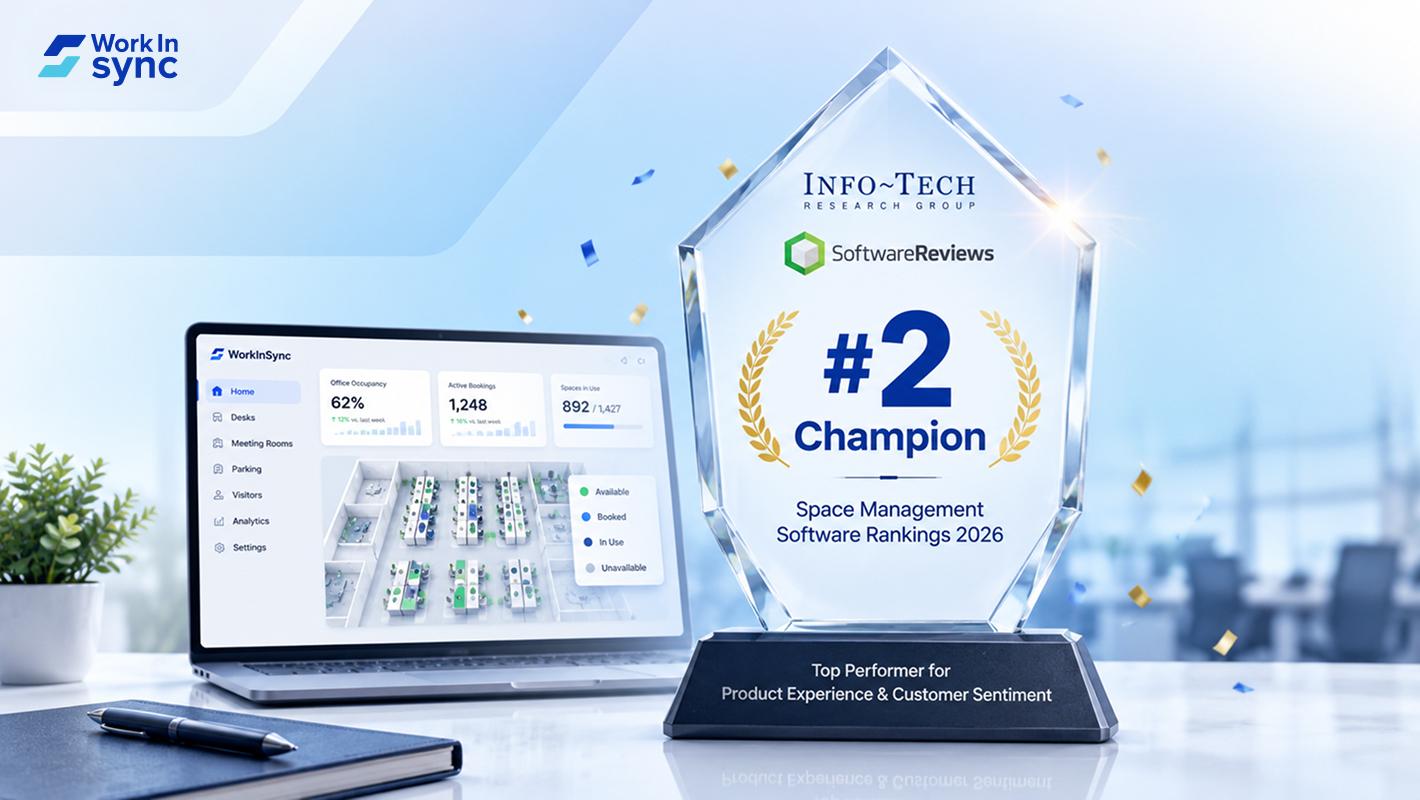
WorkInSync has been recognized by Info-Tech Research Group as a Champion in the 2026 Data Quadrant for Space Management, ranking #2, and as a Champion in the Emotional Footprint, ranking #2. Both awards are published on SoftwareReviews, Info-Tech's ratings platform, where rankings are built entirely from user feedback.

Sai Riddi
|
2 Min Read
Read More
 Desk Booking Software
5 June 2026
Let’s not pretend otherwise. Somewhere in your organization, a well-meaning IT or facilities team rolled out a desk booking system. There was a demo. Someone said “seamless.” There may have been a slide with the word “frictionless” on it. Leadership nodded. Procurement signed off. And then employees quietly went back to texting each other on […]

Ujjwal Trivedi
|
6 Min Read
Read More