
 Workplace Management
24 September 2026
Best Workplace Management Software in 2026: 6 Tools Compared
Compare six workplace management platforms. See what each is suited for and how to choose the right fit in 2026.

Deesha
|
4 Min Read
Read More


Key Takeaways
Employees prefer remote flexibility, while executives push for higher office attendance, creating inevitable workplace friction.
Key concerns include safety, disrupted routines, domestic responsibilities, and increased workloads in post-pandemic office settings.
HR must balance employee needs with organizational priorities to ensure a smooth, fair return-to-office program.
Hybrid models should be tailored by role, considering collaboration needs, equipment access, and confidentiality requirements.
Flexibility is vital, as employees favor remote days while most employers expect greater in-office presence.
Challenges include addressing fears, managing disrupted routines, and designing equitable hybrid policies for all employees.
Technology solutions support smoother transitions with scheduling, productivity tools, collaboration platforms, and digital onboarding processes.
A humane, empathetic approach with clear communication and structured planning ensures successful workplace transitions.
In the past few months, most of us have faced extended workdays, Zoom fatigue, blurring lines between personal and professional lives, and occasional bouts of social isolation. Such inconveniences make us detest the concept of work from home. On other occasions, it feels like a dream come true. How would you feel if you are suddenly asked to work from office?
A survey by LiveCareer says around 61% of employees want to continue working from home, and 29% would actually quit if forced to return to the office. Businesses, on the other hand, need particular functions to operate from a designated office space.
Given a chance, most executives would like to have their entire teams back.
In a PWC survey,75% of executives expect at least 50% of employees to return full-time by July ’21. That’s in sharp contrast to 61% of employees, who wish to spend only half their time in the office. The transition back to the office could thus be a cause of friction between employers and employees.
Hence, the HR and workplace managers will have to plan and execute a smooth back-to-office program.

● Health and safety: The concerns about health, due to lack of sanitation and adequate social distancing, loom large.
● Disturbed routines: Work minus the commute and dressing up has made people adapt to a different pace and lifestyle; changes could be upsetting.
● Domestic responsibilities: Just as the routines changed, most of our domestic roles have also evolved. Reverting or figuring out alternatives could take time.
● Change of work environment: Working at an office and working from the comfort of your home are two different things (pajamas no more!). It could adversely affect productivity.
● Change in priorities and workload: As managers find it easy to delegate work in-person, low-priority tasks could start taking precedence. Employees, therefore, expect the workload to increase.
The HR and workplace managers need to decide the best working model based on employee concerns and job requirements.
Bonus Read: Managing a team in hybrid workplaces
Here is a list of five working models. Depending on the requirement, businesses could choose a different model for each job or function.
The working model you choose would vary based on your requirements. Adopt what is best suited for the organization, job titles, and functions in the long run. Here is a list of questions that can help you decide the working model for each job:
a. Does the job involve on-site client interaction? If so, how regularly and when?
b. Is there a need for specialized equipment or facilities? You obviously cannot move manufacturing or testing equipment to homes!
c. Does the job require close supervision, and non-compliance carries a high cost? Take, for instance, auditing!
d. Is it something that requires cross-functional collaboration? Or does it demand frequent interactions between multiple team members? Typically, operations-intensive jobs are difficult to carry out from home.
e. Is it classified or confidential work? Understandably, high-stakes research work or jobs involving innovation cannot be done at home.
After a year-long of wearing pajamas to meetings, returning to the office will not be a comfortable change. Some of the major challenges for HR and workspace managers include:
a. The first challenge would be to make the transition smooth and frictionless. Addressing it would require clearly laying out the objectives, planning, and frequently communicating with all the stakeholders involved.
b. The second challenge would be the breadth of employee concerns like fear, disrupted routines, psychological issues, and reward-risk inequities. Handling these issues will demand high levels of empathy and maturity.
c. Devising policies to fit the new normal will be a massive challenge. Flexibility is no longer a matter of choice; it is one of the most important aspects of hybrid working. According to the PwC US Remote Work Survey, 55% of employees prefer three days of remote work every week. However, 68% of employers want them to be at work for the same time or more.
Therefore, HR and workplace managers will have to spend more time counseling, coaching, and reengineering the culture. Additionally, they will also have to ensure productivity and efficiency do not suffer. Leveraging technology can make the job easier.
i. Scheduling/rostering: The success of a hybrid working model depends on effective rostering. WorkinSync’s team planner solution can help you do it better.
ii. Productivity/performance management: This will make the review process transparent for both on-site and remote employees, further keeping the perception of reward inequity at bay.
iii. On-site collaboration tools to minimize interaction: With an on-site collaboration tool, the usual work processes can be made seamless. And interactions could be limited to occasions where it is actually helpful or essential.
iv. Recruiting/on-boarding: From gamification of the selection process to virtual coffee chats during onboarding, HR leaders can leverage technology to make the hiring process efficient and effective.
v. Infrastructure (to ensure compliance): Technology could make regulatory compliance a lot easier. For the sanitization requirements, several robotic and AI-based solutions are now available in the market.
Read more: How technology can help reopen offices
Balancing employee concerns, business needs, and expectations of the leadership team isn’t easy. First up, it is necessary to acknowledge that we are in unknown territory. There are no historical precedents or case studies on planning a ‘return-to-office’ program for the entire workforce. The possible repercussions of it are also tough to predict.
The only know-how is that we are emerging from a crisis that has impacted us. It has had a far-reaching impact on our lifestyle, thought process, and wellbeing, both physical and mental. Managing the transition by the textbook rules of the pre-COVID era would be a futile exercise.
The HR and workplace managers tasked with bringing people back to the office must adopt a more humane approach. Being accommodative of employees’ needs and concerns could go a long way in setting up the organization for tomorrow.
With a long-term view, a structured plan, and adequate communication, the transition process can be made smooth and successful.
Schedule a demo with us to make a smooth transition back to the office.
 Workplace Management
24 September 2026
Compare six workplace management platforms. See what each is suited for and how to choose the right fit in 2026.
Deesha
|
4 Min Read
Read More
 Announcement
13 August 2026
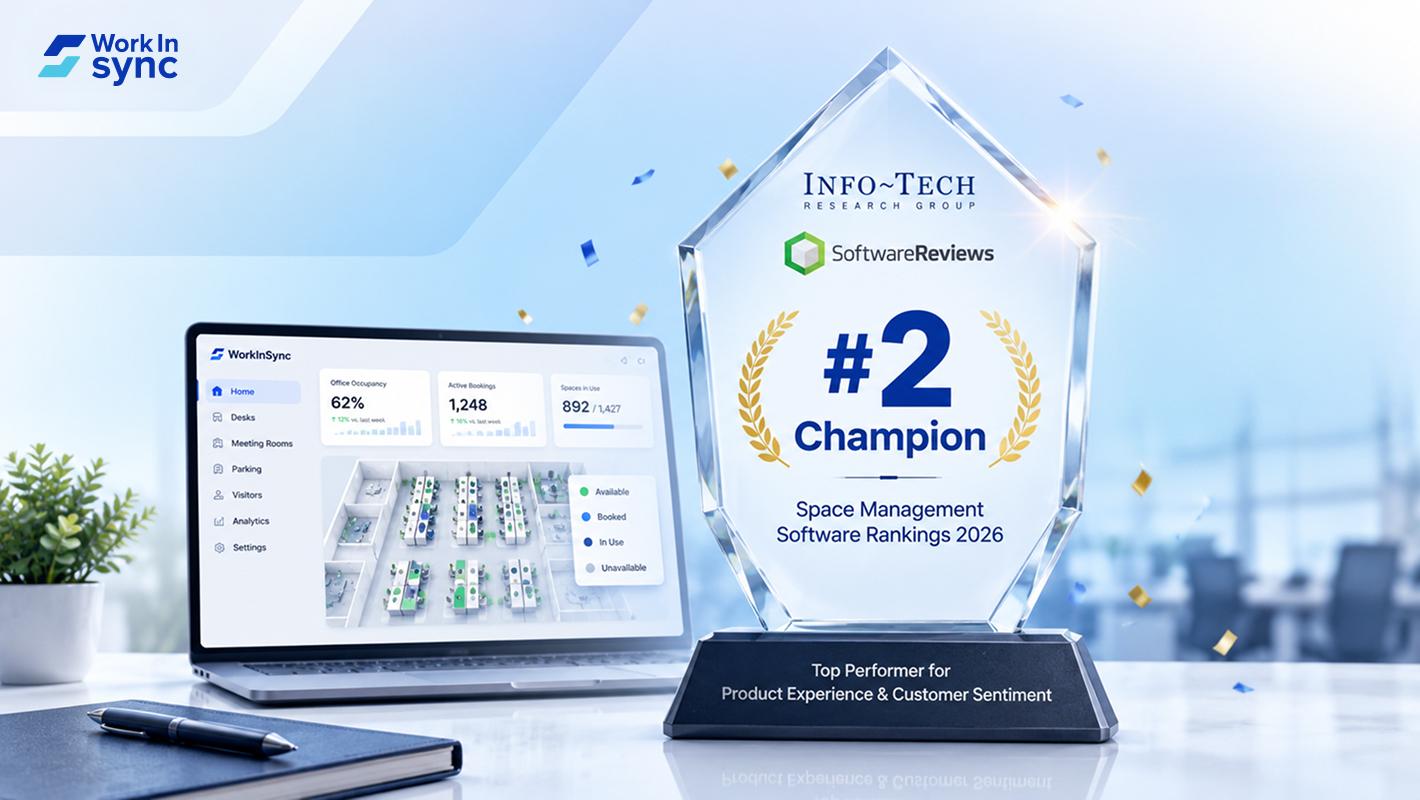
WorkInSync has been recognized by Info-Tech Research Group as a Champion in the 2026 Data Quadrant for Space Management, ranking #2, and as a Champion in the Emotional Footprint, ranking #2. Both awards are published on SoftwareReviews, Info-Tech's ratings platform, where rankings are built entirely from user feedback.

Sai Riddi
|
2 Min Read
Read More
 Desk Booking Software
5 June 2026
Let’s not pretend otherwise. Somewhere in your organization, a well-meaning IT or facilities team rolled out a desk booking system. There was a demo. Someone said “seamless.” There may have been a slide with the word “frictionless” on it. Leadership nodded. Procurement signed off. And then employees quietly went back to texting each other on […]

Ujjwal Trivedi
|
6 Min Read
Read More