
 Workplace Management
24 September 2026
Best Workplace Management Software in 2026: 6 Tools Compared
Compare six workplace management platforms. See what each is suited for and how to choose the right fit in 2026.

Deesha
|
4 Min Read
Read More


Key Takeaways
83% of CEOs want to reopen offices; WFH led to a 14% drop in productivity.
Rising healthcare costs make virus transmission control a priority for reopening.
Key pre-return factors: reopening goals, employee health, costs, flexibility, and updated policies.
Phased reopening with health protocols ensures safer return to office.
Scheduling and rostering tools help manage phased attendance and productivity tracking.
Entry wellness checks form the first line of defense against infection.
Desk and meeting room booking software supports social distancing and efficient space allocation.
Hybrid workspaces and remote collaboration tools remain essential for group activities.
Timely employee communication is critical for safety and engagement.
Cybersecurity upgrades are vital for both office and remote setups.
A workplace study released by Louis Carter and the Best Practice Institute (BPI) says 83% of CEOs want to reopen offices and get their employees back in the office. Aternity report in July 2020 stated that while 85% of employees were working from home, their overall productivity dropped by 14%. Employers could see an increase in healthcare costs, which is already high at $530bn.
Controlling the transmission of the virus can keep healthcare costs in check. Doing so will require a slew of changes resulting in a workspace befitting the new normal. Keep scrolling to know more about how to reopen safely and the best ways to do so.
Recommended Reading: 73% of CEOs Prefer Flexible Work Model
Reopening the office and asking employees to come back is a complicated process. You need to consider a few points before you embark on the return to office strategy.
Before you start to call employees back, decide what you wish to achieve. Has productivity been affected? Is it a particular function or team that needs to meet regularly? Is a collaboration between multiple departments the actual problem?
Deciding if it is a short-term morale-boosting exercise or a long-term strategic move will help you justify the investment in reopening the office.
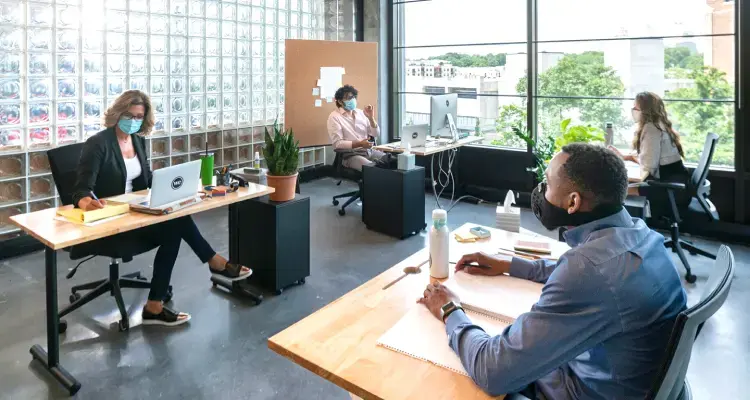
Employee health and safety should be your number one priority. A planned and phased reopening will help you implement preventive measures more effectively.
Following social distancing protocols, regularly sanitizing the workspace, and wearing masks at all times are a few factors that need consideration.
Moreover, all group activities need to be controlled by keeping in mind the safety guidelines issued by health departments.
Before you reopen your office, you need to consider the associated costs. For instance, with a hybrid workplace coming forth, do you really need that extra office space? Real-estate is a major cost and needs serious consideration before offices reopen.
Also, the cost of technological infrastructure needs to be evaluated as well. If half of the office population is working from home, how feasible is it to have desktops? Employee healthcare cost has also risen over the last one year. It is a major cost that all organizations need to consider before reopening the office.
Also Read: What are Hybrid Workplaces?
If this past year has taught us something, it is to be flexible. It is the key to keep operating. SOPs need to be created, keeping in mind that anything can happen anytime. With flexible workplaces coming to the forefront, it is necessary to keep an open mind when bringing back employees to the office.
As you reopen, you need to overhaul your policies, like leaves, medical reimbursements, and attendance, to name a few. It is also essential to get health information about the employees and understand their willingness to come to the office. The old policies aren’t going to work. Reviewing and changing them should be one of the major considerations when getting your employees back to the office.
COVID19 has accelerated digital transformation. As Zoom calls replaced meeting rooms and digital passes nullified biometric use, the strategy for returning-to-office revolves much on technology.
Here are eight technological interventions that can be instrumental when opening offices safely.
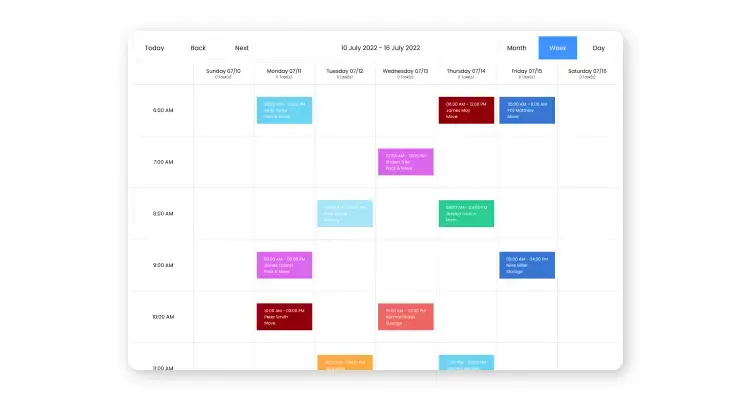
A phased reopening will call for weekly rosters, prioritizing, and scheduling work. The number of variables involved will be high. Manual management would be an uphill task. Workinsync’s team planner solution factors in employee availability, locations for better work scheduling, and office visits. You can also automate monitoring employee sign-in time and get unified, real-time insights into work hours and productivity.

Open office plans have long been a subject of debate. COVID settled most of it in a single stroke – it made people stay at home and made partitions necessary.
The objective of reducing the number of people at work is to contain the spread of infection. It will remain unrealized if the density of people isn’t reduced by social distancing.
While a rearrangement of workspace might work, coupling it with a technology solution, you can make it more effective. With desk and meeting room booking software, you can prioritize and allocate space based on the requirement. WorkInSync enables your employees to book and view desk allocation with ease. Specific teams can book together while following social distancing guidelines.
Similarly, employees can schedule and book meeting rooms in advance. To top it all, WorkInSync provides ready integration with Google and Outlook calendar.
On the other hand, startups like Density, Staqu, Zensors, and Contatrak monitor occupancy and use spatial intelligence to improve social distancing and contact tracing. Using computer vision, some of these solutions monitor body temperature, employee-count, and density to provide real-time alerts and suggestions.
Bonus Read: Explaining Hoteling
Even as employees return to the office, it would be impossible to hold group meetings unless you have large spaces. This brings us to the concept of hybrid workspaces, where few activities, like team meetings, continue to happen online.
Regardless of whether you despised in-person meetings, virtual meetings have been frustrating for most. Remote collaboration through video conferencing hasn’t been the perfect substitute. Ambient noises, the absence of tools like whiteboards, and the inability to gauge the body language make it a draining experience. “Zoom Fatigue” is today a reality.
Although Microsoft and Zoom have been working to improve their collaboration tools, there’s a long way to go. Perhaps, that’s the reason why tools like Miro have registered a surge in popularity over the last year. Such collaborative tools will lead to the evolution and popularity of hybrid workspaces.
With a changing workspace, the modes of communication and engagement too will transform.
If an employee tests positive, timely communication holds the key to limiting the spread of the infection. Mobile notifications, due to their full-time connectivity, are emerging as a preferred medium. Staffbase and Happeo are a couple of companies, among many others, which are prioritizing mobile for internal communication.
Better internal communication becomes vital to manage the performance of a geographically distributed workforce. Many BI tools are now increasingly focusing on this aspect. Although most users might be unaware, Microsoft Teams captures a lot of data related to employee productivity.
Admittedly, cybersecurity isn’t a new challenge. The scale of digital transformation has amplified the problem, and so has work-from-home.
According to London-based email security platform Tessian, 48% of employees were less likely to follow safe data practices working from home.
The number of phishing attempts has also seen a drastic rise since the pandemic began. Senior leadership and finance teams are understandably a high-risk category.
While reopening, it is critical to update and upgrade your cybersecurity systems to ward off any threat.
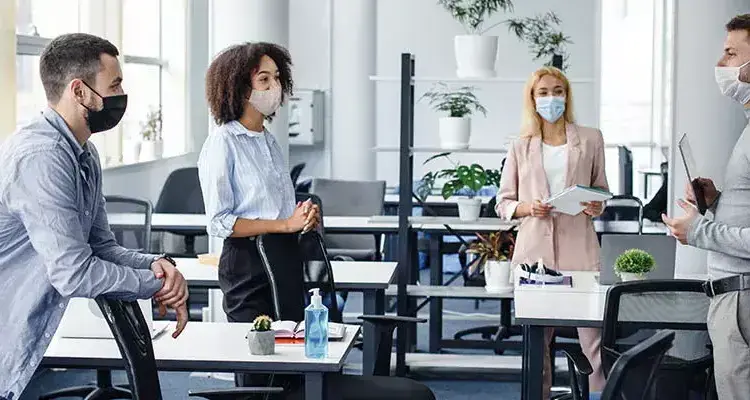
Even as tech majors extend work from home, 2021 will witness the gradual reopening of office spaces. As more people return to the office, the workspace dynamics will not be the same as in the pre-COVID era.
Physical distancing that was innocuously referred to as social distancing may end up actually resulting in one. After seven months of restricted mobility and being stuck at home, people would have developed new routines and work approaches. An abrupt shift or forced compliance would lead to the same discomfort that sudden imposition of work-from-home did. The new office culture will have to assimilate and accommodate the deviances for quite some time to come.
Reopening isn’t just about boosting productivity or employee morale; it should help companies gain momentum and stay ahead of the curve. At the same time, companies should ensure the safety of employees to the best extent possible.
Opt for a free demo today and witness these workplaces transforming features yourself. To stay on top of the hybrid workplace trends, follow our social media channels, and subscribe to our blog.
 Workplace Management
24 September 2026
Compare six workplace management platforms. See what each is suited for and how to choose the right fit in 2026.
Deesha
|
4 Min Read
Read More
 Announcement
13 August 2026
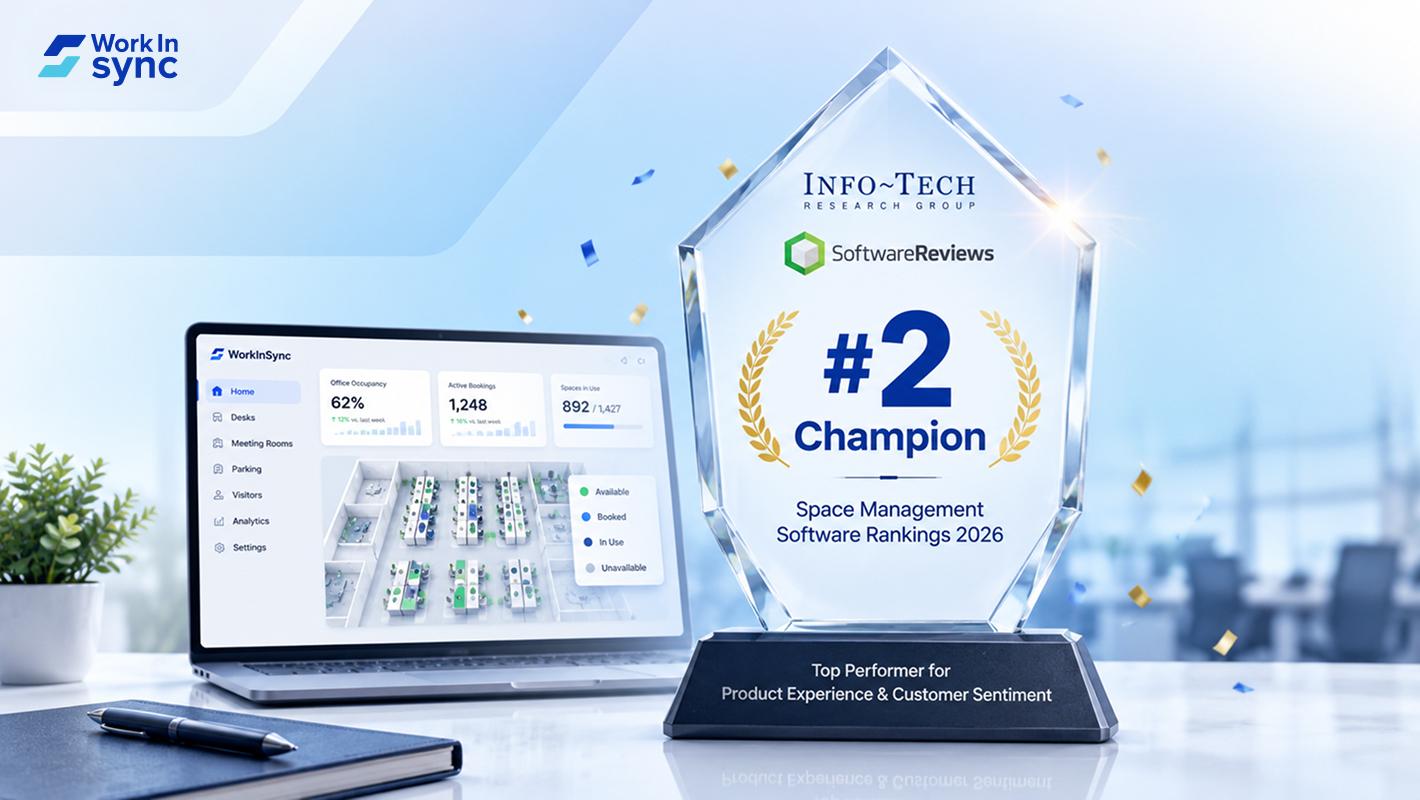
WorkInSync has been recognized by Info-Tech Research Group as a Champion in the 2026 Data Quadrant for Space Management, ranking #2, and as a Champion in the Emotional Footprint, ranking #2. Both awards are published on SoftwareReviews, Info-Tech's ratings platform, where rankings are built entirely from user feedback.

Sai Riddi
|
2 Min Read
Read More
 Desk Booking Software
5 June 2026
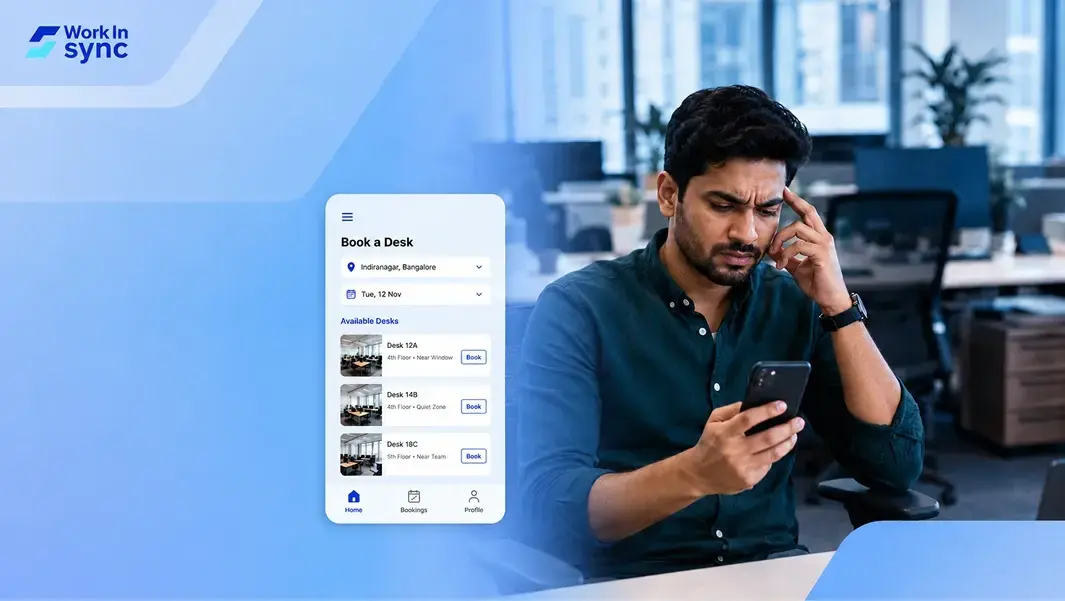
Let’s not pretend otherwise. Somewhere in your organization, a well-meaning IT or facilities team rolled out a desk booking system. There was a demo. Someone said “seamless.” There may have been a slide with the word “frictionless” on it. Leadership nodded. Procurement signed off. And then employees quietly went back to texting each other on […]

Ujjwal Trivedi
|
6 Min Read
Read More