
 Workplace Management
24 September 2026
Best Workplace Management Software in 2026: 6 Tools Compared
Compare six workplace management platforms. See what each is suited for and how to choose the right fit in 2026.

Deesha
|
4 Min Read
Read More

Key Takeaways
Point tools solve single problems, while an IWMS unifies space, assets, maintenance, and workplace services into one system.
Fragmented tools create data silos, manual work, and inconsistent records that slow operations and decision-making.
Lack of real-time visibility forces teams to react to issues instead of proactively managing workplace operations.
Scaling with point tools increases costs, integrations, and operational complexity across teams and locations.
An IWMS centralizes data, automates workflows, and improves execution speed across workplace functions.
Real-time analytics enable better decisions on occupancy, maintenance, energy use, and cost optimization.
Upgrade when manual effort, inefficiencies, hybrid complexity, or leadership demand for insights exceed current tool capabilities.
Use measurable criteria like volume, process gaps, time spent, costs, and visibility issues to evaluate readiness for IWMS adoption.
As a Workplace or Facility Manager, you likely manage a patchwork of scheduling apps, spreadsheets, and maintenance tools that never quite talk to each other. When those gaps cost time, money, or visibility, moving from point tools to an Integrated Workplace Management System (IWMS) is no longer optional, it becomes a strategic move. An IWMS centralizes data and workflows so you can make faster, smarter decisions about space management, resource maintenance, and costs.
You should upgrade when fragmented tools create repetitive work, blind spots, or missed optimization opportunities that an integrated platform would eliminate. This article shows practical signs to watch for, how an IWMS changes daily operations and long-term planning, and the criteria to use when evaluating a platform so you buy for impact, not hype.
Point tools are single-purpose workplace management software applications that solve one specific problem, for example, meeting room booking, maintenance ticketing, or asset tracking. You can deploy them quickly and they often offer deep functionality in their niche.
An Integrated Workplace Management System (IWMS) is a unified platform that combines multiple workplace management functions like space management, and workplace services, into a single system. You gain consistent data, standardized processes, and cross-module visibility.
You should view point tools as quick, targeted fixes and an IWMS as the foundational platform for your workplace technology stack. If your goals include accurate occupancy insight, or consolidated reporting, an IWMS aligns those outcomes through shared data and workflows.
Consider hybrids: modern IWMS platforms often support integrations with best-of-breed point tools, letting you keep specialist capabilities while building a unified workplace management software foundation.
You see repeated data silos across teams and systems. Information lives in separate applications, forcing manual reconciliation and creating inconsistent records.
Manual coordination consumes your operations time. Technicians, finance, and facilities teams spend hours on spreadsheets and email threads instead of on strategic work. You lack real-time visibility into workplace assets, utilisation, and costs. That gap slows decision-making and leaves you reacting to issues instead of preventing them.
Scalability becomes painful as your organization grows. Adding new sites or users multiplies integrations and licensing costs, and performance degrades under heavier loads.
Reporting and analytics deliver limited insight. You stitch together reports from multiple sources, which delays forecasting and hides the true total cost of ownership.
You face integration and migration risk when processes change. Each new tool adds another point of failure and increases the effort required to unify workflows later.
High recurring costs and tool redundancy drain budget. Many point solutions overlap functionally, so you pay for similar features across vendors without gaining centralized control.
If these patterns match your experience, they signal that a more integrated IWMS could reduce friction, improve visibility, and scale with your needs.
An IWMS centralizes your workplace data into a single, trusted source. With unified records for space and assets, you spend less time reconciling spreadsheets and more time acting on facts.
Workplace automation reduces routine work and speeds execution. From automating desk and room bookings to simplifying visitor management and access workflows, it cuts manual effort and helps teams move faster with fewer dependencies.
Real-time insights improve the speed and quality of decisions. Dashboards and live workplace analytics show occupancy trends, space usage, booking patterns, and demand trends so your team can plan better and respond faster to changes.
You can measure and optimize your real estate footprint. Consolidated data reveals underused space and opportunities to repurpose or reduce leased square footage, producing measurable cost savings.
An IWMS enhances the employee workplace experience through clearer service workflows. Mobile access for reporting issues, meeting room booking, and workplace wayfinding makes interactions smoother and reduces friction for hybrid teams. Solutions such as WorkInSync also layer in AI assistants and real-time coordination, simplifying everyday interactions for both employees and admins.
Use the platform to enforce compliance and sustainability goals. Centralized tracking of certifications, inspections, and energy metrics makes audits simpler and supports measurable progress toward targets.
Key benefits at a glance:
Unified data: one database for all workplace information.
Automation: fewer manual tasks and faster processing.
Real-time visibility: live metrics for better decisions.
Improved experience: simpler services for employees.
Cost and space optimization: data-driven actions.
You should evaluate readiness using concrete triggers that reveal limits of point tools. If your facility portfolio or headcount has grown significantly, scale becomes a tipping point; manual work multiplies and spreadsheets fracture.
Cost inefficiencies show up as hidden labor, duplicate purchases, or high vendor fees. Track total cost of ownership for current tools versus estimated workplace management platform costs to spot when savings outweigh transition effort.
Hybrid work and space complexity strain simple tools. If reservation conflicts, utilization blind spots, or compliance gaps increase, an integrated system can reduce friction and risk.
Leadership demand for actionable insights matters. When executives ask for real-time dashboards, predictive workplace analytics, or consolidated reports you cannot produce, that signal often drives procurement decisions.
Use practical, measurable criteria to decide:
Volume: number of facilities, assets, or bookings exceeding manual capacity.
Process: percentage of workflows handled outside core systems (high indicates fragmentation).
Time: hours per week spent reconciling data or fixing errors.
Cost: recurring inefficiencies, overtime, or supplier redundancies.
Visibility: frequency of missed SLAs, occupancy forecasting failures, or audit findings.
Modern platforms like WorkInSync are built to directly solve these gaps by consolidating bookings, usage data, and operational workflows into a single system. It automates routine tasks like space allocation and issue tracking, and gives teams real-time visibility into occupancy, utilization, and service performance without manual reconciliation.
You gain strategic flexibility by moving from point tools to an integrated workplace management system when your needs exceed isolated feature sets. An IWMS reduces duplication, centralizes data, and lets you scale processes across real estate, facilities, and workplace services.
If you need interoperability, fewer vendor relationships, and a foundation for advanced analytics, an IWMS becomes the logical next step. Platforms like WorkInSync bring these capabilities together in a single system, helping teams move from fragmented operations to more structured, data-driven workplace management.
Choose a solution that aligns with your scale, security requirements, and long-term technology strategy.
 Workplace Management
24 September 2026
Compare six workplace management platforms. See what each is suited for and how to choose the right fit in 2026.
Deesha
|
4 Min Read
Read More
 Announcement
13 August 2026
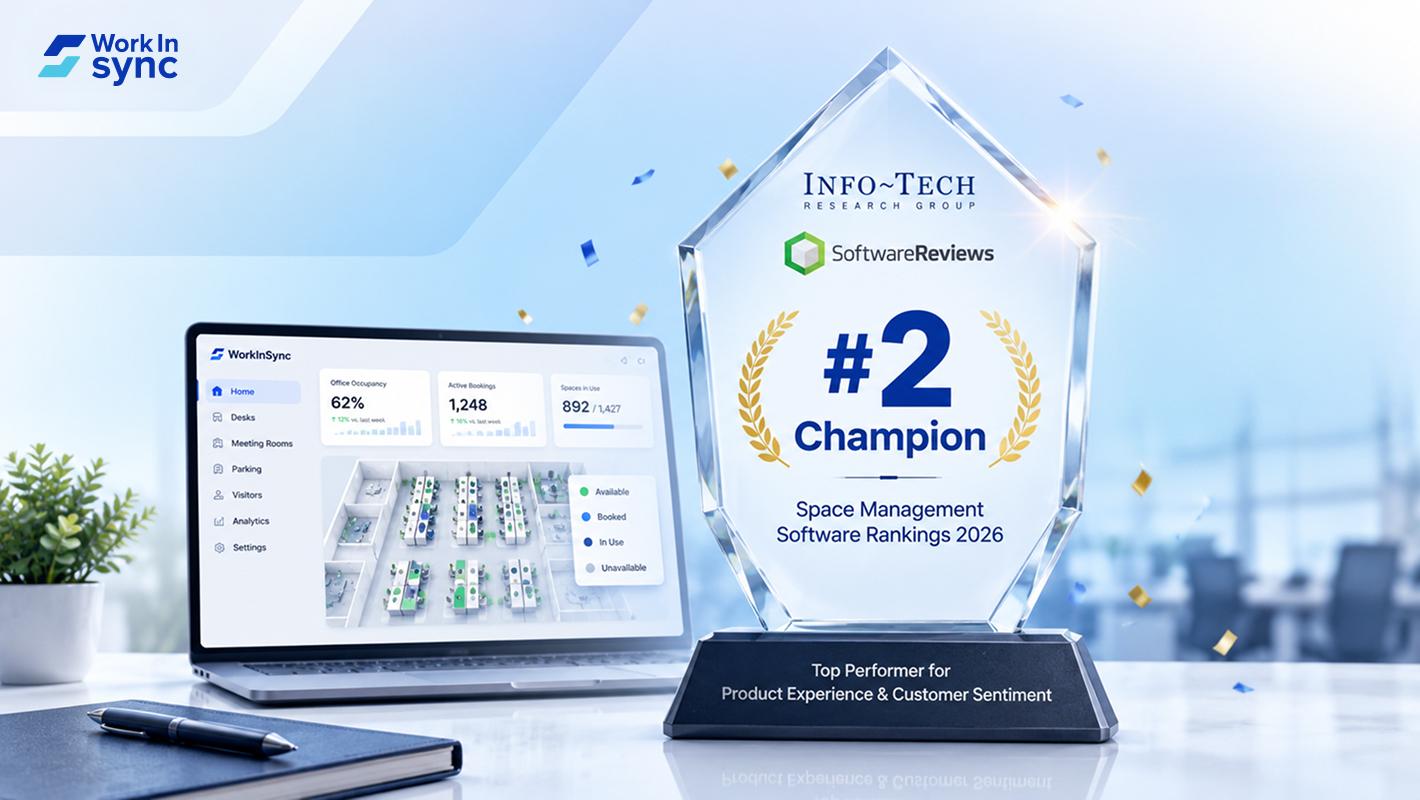
WorkInSync has been recognized by Info-Tech Research Group as a Champion in the 2026 Data Quadrant for Space Management, ranking #2, and as a Champion in the Emotional Footprint, ranking #2. Both awards are published on SoftwareReviews, Info-Tech's ratings platform, where rankings are built entirely from user feedback.
Sai Riddi
|
2 Min Read
Read More
 Desk Booking Software
5 June 2026
Let’s not pretend otherwise. Somewhere in your organization, a well-meaning IT or facilities team rolled out a desk booking system. There was a demo. Someone said “seamless.” There may have been a slide with the word “frictionless” on it. Leadership nodded. Procurement signed off. And then employees quietly went back to texting each other on […]

Ujjwal Trivedi
|
6 Min Read
Read More